
Toolkit
Shadow AI Audit
Learn more
The Capability and Readiness Audit is a board level diagnostic designed to help leadership teams assess whether they are equipped to govern AI responsibly.
It helps you answer a critical question: Does our leadership team have the capability to govern AI, and have we put the right structures in place to support responsible adoption?
Scope note: This audit covers governance capability, the ability to oversee and direct AI responsibly. It is distinct from a staff skills or training audit. Both tracks are designed for leadership teams and boards, not technical teams.
Most organisations now use AI. Fewer have thought carefully about whether they are governing it well. This tool helps you answer that question honestly, across two connected dimensions.
Can your leadership team govern AI? This track assesses whether directors have the literacy, oversight skills, and regulatory awareness to discharge their governance duties.
Has the organisation built what it needs? This track assesses whether the structures, policies, and culture are in place to support responsible AI adoption.
Questions are behavioural and evidence-based, not confidence ratings. The assessment is designed to surface real gaps, not ratify stated positions. Research consistently shows that boards overestimate governance capability when asked attitudinally: the gap between 'we feel confident' and 'we can demonstrate it' is where most AI governance failures occur.
Output: A maturity profile across both tracks, scored at one of four stages: Ad Hoc, Emerging, Structured, or Integrated. The profile highlights your most significant gaps, flags regulatory exposure under the EU AI Act and Ireland's Regulation of AI Bill 2026, and produces a prioritised action list scaled to your organisation's size.
The audit is designed for collective completion by the leadership team - not individual self-assessment. When directors complete it together and must agree on a score, disagreement between them is itself a governance signal.
The audit produces a structured maturity profile across both tracks. Each of the eleven domains is scored at one of four stages.
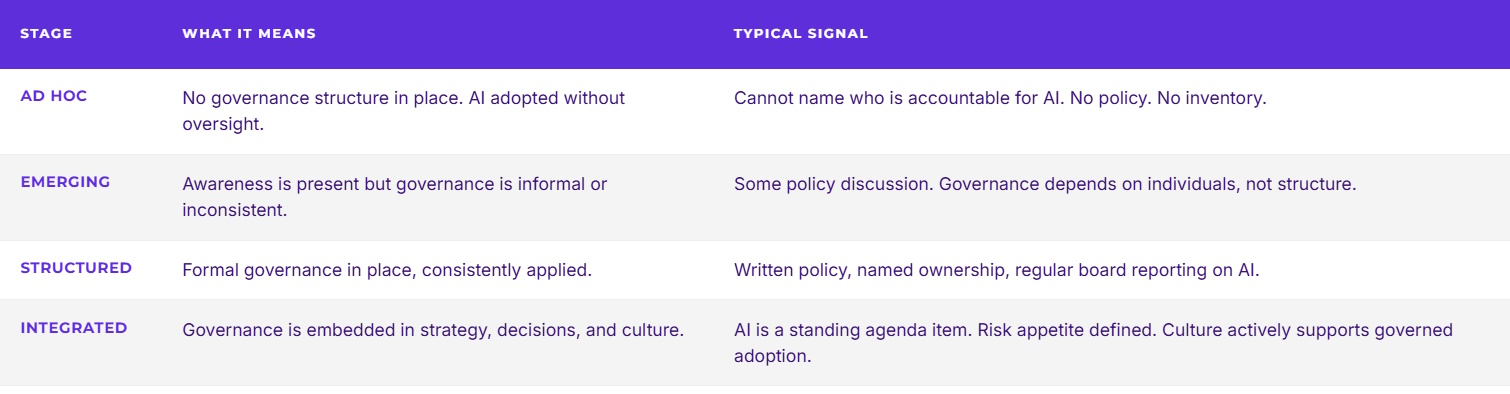
Most Irish SME boards are currently operating between Ad Hoc and Emerging. The audit helps you identify where you actually sit, not where you believe you sit.
Reporting statement
"Capability & Readiness Audit completed [date]. Director capability: [stage]. Organisational readiness: [stage]. Priority gaps: [top 2–3 domains]. Next review: [date]."
The EU AI Act Article 4 AI Literacy Obligation (in force since February 2025) notes that: Organisations that deploy AI systems must ensure a sufficient level of AI literacy among staff and others dealing with AI, including directors and board members who receive AI-generated outputs or oversee AI-enabled functions. This is a binding obligation, not a recommendation. The Capability and Readiness Audit provides a structured way to demonstrate compliance with Article 4.
Regulation of Artificial Intelligence Bill 2026, Enforcement from August 2026: Ireland's AI Office (Oifig Intleachta Shaorga na hÉireann) must be operational by 1 August 2026. The enforcement architecture covers 13 sectoral regulators. Penalties for serious violations reach 7% of worldwide turnover. Directors of deploying organisations carry personal governance exposure. The window to build capability before enforcement is now.
Director and Officer Liability: AI governance has become a personal liability issue. Where AI systems mediate compliance, safety, or customer decisions, boards must demonstrate that adequate oversight structures exist, not merely that AI was delegated to management. Delegation does not dilute fiduciary duty. The audit helps directors evidence that they have discharged their oversight obligations.
Track progress across both leading and lagging measures. The goal is not a high score - it is honest diagnosis followed by targeted improvement.
Position As: A diagnostic, not a test. The goal is an honest picture of where you are, not a high score. Frame it as the starting point for better governance, not an assessment of past performance.
Involve: Complete as a leadership team, not individually. Include both executive and non-executive directors where both are present. Disagreement between participants is itself useful data, don't smooth it over.
Common Resistance: 'We already have governance in place.' Counter by explaining that governance theatre, structures that exist on paper but don't function, is the most common finding in AI governance assessments. The audit tests substance, not form.
Quick Win: After the first session, pick the single highest-impact gap and assign a named owner with a four-week deadline. Completing one concrete action closes the loop and builds momentum for the broader improvement plan.
Everything you need to run the audit, from the boardroom session to the gap map.
Disclaimer
The AI Governance Toolkit is provided by the Institute of Directors (IoD) Ireland for general informational purposes only. It is intended as a practical guide to support members. The toolkit does not constitute legal, regulatory or professional advice. IoD Ireland accepts no liability for any loss, damage or consequence arising from the use of, or reliance on, this material.