
Toolkit
Shadow AI Audit
Learn more
The AI Quick Wins Planner helps directors and senior leaders identify, screen and prioritise the AI opportunities most likely to deliver business value inside 90 days. It is the tool that turns "we should be doing more with AI" into a sponsored, measured, governed shortlist.
The bullets below outline a practical, end-to-end approach - defining what a credible AI quick win looks like, how to identify and prioritise opportunities, and how to govern, sponsor and measure them effectively.
The simple rule - If it needs a policy exception, a Data Protection Impact Assessment (DPIA), a new platform, or a six-month programme - it is not a quick win. Park it on the AI roadmap and keep this planner clean.
AI scope. Quick wins are not limited to generative AI. They include AI-assisted analytics, automation platforms, and any tool with a significant AI component - wherever real value can be proven inside a quarter.
Run the tool in five steps over a two-to three-week window. Each step has a matching sheet in the downloadable Excel workbook.
1. Source candidate opportunities
Start with what you already know. Members who have completed the Shadow AI Audit should treat its MONITOR and FORMALISE rows as their first candidate pool - these are workflows where AI is already in use, ready to be made formal.
Members who have completed the Capability & Readiness Audit will find some quick wins suggested by capability strengths the team has but isn't yet exploiting. If you haven't done either yet, source from: front-line teams (who already pastes into ChatGPT?), back-office (repetitive copy/paste, manual reconciliation), board-pack production (manual collation, executive summaries), recent vendor demos. Aim for 15–25 candidates before you start filtering. The "From Prior Tools" sheet in the workbook walks through this in detail.
Watch for: do not start with vendor demos. Start with business friction.
2. Screen for governance fit
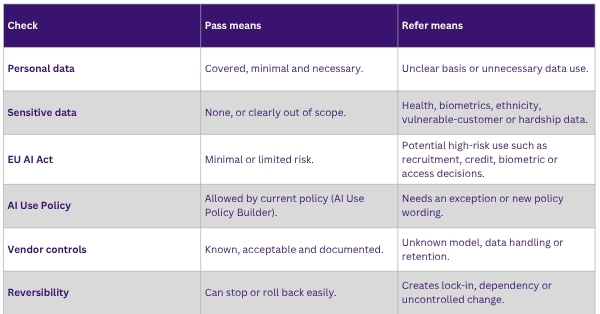
Run each candidate through the six-point screen: personal data, special-category or high-sensitivity data, EU AI Act classification, AI Use Policy Builder fit, vendor due diligence, reversibility. Anything marked Refer moves out of the quick-win pool. If you don't have an Acceptable Use Policy yet, complete the AI Use Policy Builder before scoring any candidate.
Watch for: a risky idea may still be valuable. It just belongs on the roadmap, not in this 90-day planner.
3. Score with two plain-English questions
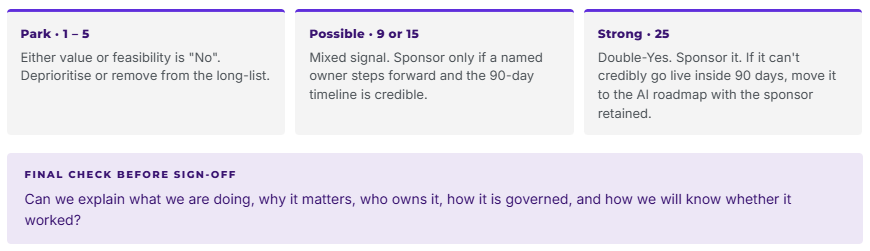
We ask two questions per candidate - will this move a number leadership watches? (Yes / Partly / No) and can we deliver it with what we already have? (Yes / Mostly / No). The Excel turns those answers into a priority score automatically (Yes = 5, Partly/Mostly = 3, No = 1; Priority = Value × Feasibility, max 25). No 1–5 spreadsheet maths required.
Watch for: avoid false precision. This is a prioritisation tool, not a business-case model.
4. Sponsor your top three
Complete a one-page sponsor brief for each of the top three. Each needs a named business owner, an executive sponsor, an estimated annual value, a single KPI, and a go-live date inside 90 days.
Watch for: committees do not own quick wins. People do.
5. Lock measurement before launch
Capture a 4-week baseline, name a measurement owner, schedule day 30, 60, 90 reviews, and document the roll-back plan. Without this, the quick win is anecdote, not evidence.
Watch for: without a baseline, the story becomes anecdotal - and anecdote will not survive a board challenge.
Governance screen - at a glance
Run this screen at Step 2 (Screen for governance fit), before you score any candidate. Anything in the Refer column is parked or moved to the AI roadmap.
How to read the score
Because Value and Feasibility each score 1, 3 or 5, the only possible priority scores are 1, 3, 5, 9, 15 or 25. The bands below cluster those into action tiers.
When you complete the tool you will have:
What this is NOT
This is not your full AI strategy. Quick wins are the operating-model proof point - evidence that you can move from idea to value safely with governance intact. Longer-cycle initiatives belong in your broader AI roadmap, alongside the Capability & Readiness Audit.
Three regulatory threads matter for quick wins. The governance screen at Step 2 (Screen for governance fit), under the How to Use It dropdown, checks all three below.
Track these reporting metrics quarterly:
The planner is a quarterly habit, not a one-off exercise. Embed it through these six disciplines:
One asset. The Scoring Workbook runs the whole process - long-list, screen, score, sponsor, sign off. This page is the reference guide; bookmark it to refer back offline. (Suggested cadence. Run the planner once per quarter- ideally aligned to your board reporting cycle. Two to three weeks from kickoff to sponsored shortlist. Day 30, 60, 90 reviews for each sponsored quick win).
Disclaimer
The AI Governance Toolkit is provided by the Institute of Directors (IoD) Ireland for general informational purposes only. It is intended as a practical guide to support members. The toolkit does not constitute legal, regulatory or professional advice. IoD Ireland accepts no liability for any loss, damage or consequence arising from the use of, or reliance on, this material.