
Events
Driving Competitiveness Through Ireland’s EU Presidency
The Westbury Hotel, Dublin 2
In partnership with KPMG
Learn more
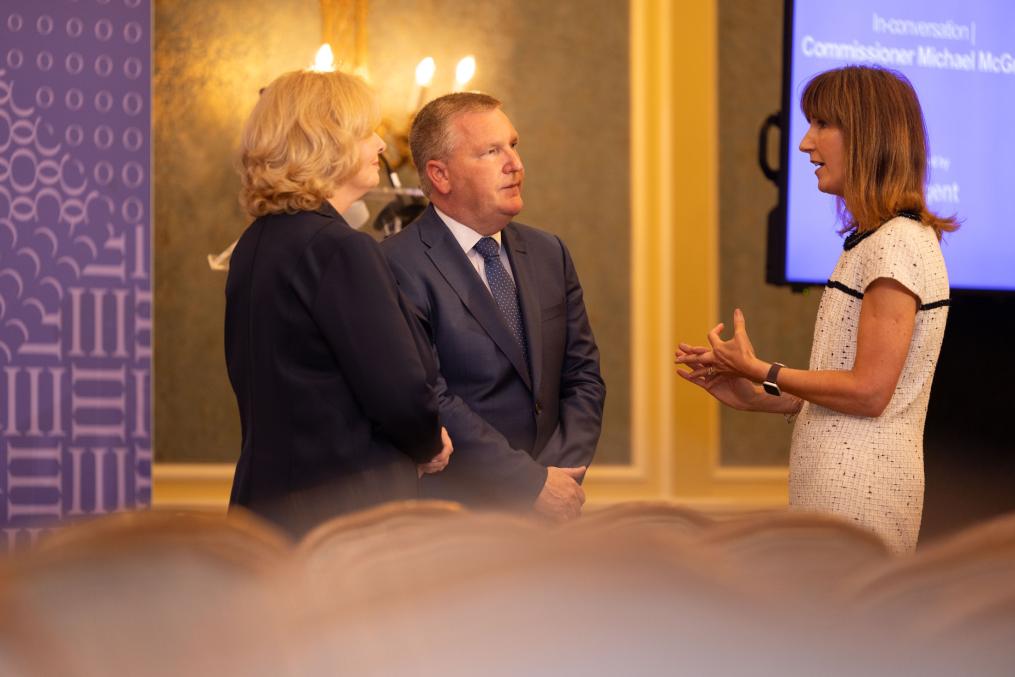
In this article, Dr Caroline Spillane CDir, CEO, Institute of Directors Ireland, reflects on Ireland’s Presidency of the Council of the European Union, highlighting there is a clear sense of both opportunity and responsibility.
IoD Ireland’s latest research among directors and business leaders highlights that Ireland’s EU Presidency will be judged on one critical measure: competitiveness. For many organisations, the Presidency, which commences today, represents a chance for Ireland to shape the European agenda at a time of significant global uncertainty. But it also brings heightened expectations, and heightened exposure.
In our latest research, Directors and senior business leaders have been clear in their message: strengthening competitiveness must sit at the heart of Ireland’s EU Presidency.
This aligns with the Government’s stated ambitions, but it also reflects a deeper concern within boardrooms. Competitiveness is no longer an abstract policy goal, it is central to growth, investment, and Ireland’s ability to retain its position as a leading location for business in a rapidly changing European and global landscape.
Our research shows that business leaders expect tangible progress in this area. They want to see action that supports productivity, innovation, and sustainable growth, alongside a regulatory environment that enables rather than constrains enterprise.
However, with increased visibility comes increased vulnerability. Nearly half (46%) of Irish businesses believe that cyber risk will increase during Ireland’s EU Presidency. This is an important finding and one that boards cannot ignore. As Ireland takes on a leadership role within the EU, organisations recognise that they may become higher-profile targets, particularly where critical infrastructure or sensitive data is concerned.
With the transposition of the NIS2 Directive into national law on the cards, directors need to be clear on their duties and responsibility in this area. If you are a director in one of the regulated entities, NIS2 mandates board-level accountability. This includes personal liability for directors in cases of severe non-compliance.
In this context, cybersecurity is no longer solely an operational issue. It is a strategic boardroom priority, requiring oversight, investment, and a clear understanding of evolving threats, particularly in an environment of rapid digital transformation and AI adoption. At IoD Ireland we will continue to support our members in this area, through our ongoing learning and education opportunities, such as our dedicated workshop on Cyber Security and Data Protection Governance, as well as our thought leadership events, and governance resources and supports.
While the Presidency creates momentum at a European level, our findings also highlight a more cautious sentiment regarding the domestic environment. Almost half (48%) of respondents believe that Government performance has had a negative impact on consumer confidence. At the same time, nearly one-third (32%) of our respondents expressed a lack of confidence in the management of public finances, with 51% ranking they were somewhat confident, and 16% noting they were very confident. This matters. Confidence, both consumer and business, is a critical foundation for economic stability. Without it, even well-intentioned policy initiatives can struggle to gain traction.
There are also mixed expectations for organisational performance in the second half of the year, with more leaders expressing pessimism than optimism about the outlook. Taken together, these signals point to a delicate balance: Ireland has an opportunity to lead at EU level but must also reinforce confidence at home.
For directors, the implications are immediate. Boards must respond to a more complex operating environment, one where competitiveness, risk, and resilience are increasingly interconnected. The findings from our research underline the need for:
At the Institute of Directors Ireland, we remain committed to equipping directors and boards with the tools to navigate today’s challenges and seize future opportunities. We are a support network for our community of business directors and leaders. Contact. Do reach out to me or the team if we can provide any governance support.
This article is the view of the author(s) and does not necessarily reflect IoD Ireland’s policy or position.

Dr Caroline Spillane CDir is Chief Executive Officer of the Institute of Directors Ireland. At IoD Ireland Caroline Spillane leads the strategic direction of a 3,600-membership body dedicated to supporting directors while advancing high standards of governance nationally. Caroline has held several senior leadership roles including as Director General of Engineers Ireland, the all-Ireland professional body for engineers, CEO of the Medical Council of Ireland, the independent statutory regulator of over 25,000 medical practitioners and Assistant National Director of the Health Services Executive.
Caroline is also an experienced Non-Executive Director and Committee Chair serving as a board member of ESB Networks and Irish Manufacturing Research. She is also a member of the Advisory Group to Balance for Better Business, an independent business-led Review Group established by the government to improve gender balance in senior leadership in Ireland.
Events
Driving Competitiveness Through Ireland’s EU Presidency
The Westbury Hotel, Dublin 2
In partnership with KPMG
Learn more

Blog
The Priorities of the Irish Presidency of the EU – What does it mean for business?
Learn more

Blog
Ireland at the Helm: Practical Steps to be Taking Now for the EU Presidency
Learn more