Blog
The Priorities of the Irish Presidency of the EU – What does it mean for business?
Learn more
Read this exclusive article by Minister Thomas Byrne, Minister of State for European Affairs and Defence, and T.D. for Meath East. Written exclusively for IoD Ireland members, Minister Byrne outlines the aims and ambitions that will shape Ireland’s Presidency of the Council of the European Union.
When Ireland assumed the Presidency of the Council of the European Union on 1 July, the priorities for our six-month term were clear. Our core policy pillars of competitiveness, security and values are interlinked, mutually reinforcing, and reflect the key issues facing our Union. Efforts to boost competitiveness are familiar to members of the Institute of Directors. Burdensome regulation, internal market barriers, high energy costs, and access to finance are among some of the issues businesses face in a changing geopolitical landscape, and areas I know Irish firms are keen to see addressed.
Ireland is one of the EU’s economic success stories. The Single Market has been an engine of transformational and radical economic growth here and has shaped our approach to EU policymaking. It also had a positive influence in respect of the Peace Process on our island. In working to boost European competitiveness, we will utilise our experience and learnings in leading the work of the Irish EU Presidency.
The ‘One Europe, One Market Roadmap’ sets out a clear programme of work for Ireland to advance during our 2026 EU Presidency. Crucially, the ‘Roadmap’ sets out clear milestones and deliverables across more than 40 significant competitiveness files, over the next two years.
Ireland has the ambitious task of making progress on more than 20 of these files during our EU Presidency. Given Ireland’s well-established profile on competitiveness issues in Europe, I believe that we are in an ideal position to lead the EU’s work, in getting key files over the line.
As European Affairs Minister during the Irish EU Presidency, I act as Chair of the EU General Affairs Council and oversee the delivery of the ‘Roadmap’ alongside my fellow EU Ministers. At my first meeting as Chair in July, I invited Professor Enrico Letta, former Prime Minister of Italy and author of the influential ‘Much More than a Market’ report, to address our meeting. Our exchanges were stimulating and bolstered support around the EU table for the Irish Presidency’s priority focus on competitiveness over the coming months.
At the EU General Affairs Council, I am also steering the broad simplification agenda, which seeks to simplify the EU regulatory framework and reduce administrative burdens for businesses, in particular SMEs, to boost the EU’s long-term competitiveness. I believe that simplification is fundamentally about better regulation, not deregulation. It is essential that we reduce the regulatory burden, while maintaining high ambition in terms of environmental protection, fundamental rights and other standards.
Over the course of the Irish EU Presidency, our goal is to drive an ambitious and meaningful simplification agenda that delivers concrete results for businesses and citizens. At the EU General Affairs Council in July, I chaired a strategic discussion among EU Ministers on how we can drive forward this agenda. Progress has been made, but there is more to be achieved. This will be a key focus of the work of the Irish EU Presidency and the EU General Affairs Council for the rest of the year.
We will work to reach agreement with the European Parliament on proposals to simplify digital and food and feed regulations by the end of the year. At the same time, we are advancing work on two new packages put forward by the European Commission in June, on simplifying taxation and energy products regulations.
Other key which the Irish EU Presidency will seek agreement on include:
While the Irish EU Presidency is fully committed to advancing these files, there are also factors that will affect progress, including the speed at which the European Parliament can agree its positions, and the willingness of Member States to compromise in reaching a Council position.
On 3-4 September, I will host an informal meeting of the EU General Affairs Council at Dublin Castle. At that meeting, and at every meeting of the EU General Affairs under the Irish EU Presidency, competitiveness and simplification will be on the agenda, because we have no time to lose in working to make business simpler and more competitive to do in Europe.
We are leading our EU Presidency with a genuine sense of responsibility and ambition. We put in the groundwork, we know what is being asked of us, and we understand the moment in which we are being asked to deliver for Europe. We are committed to doing it well, in the interests of Europe, our people, and our businesses.
This article is the view of the author(s) and does not necessarily reflect IoD Ireland’s policy or position.
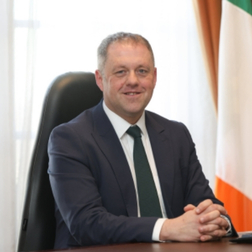
Thomas Byrne is Minister of State for European Affairs and Defence at the Department of the Taoiseach, the Department of Foreign Affairs and Trade, and the Department of Defence. Minister Byrne previously served as Minister of State for Sport and Physical Education from December 2022 until January 2025. He also held the role of Minister of State for the Gaeltacht from April 2024 until January 2025. Minister Byrne represents the Meath East constituency in Dáil Éireann and has served as a member of the Houses of the Oireachtas since 2007. From July 2020 until December 2022, he served as Minister of State for European Affairs at the Department of the Taoiseach and at the Department of Foreign Affairs. Minister Byrne was educated at St. Mary’s Diocesan School in Drogheda. He studied law at Trinity College, Dublin and trained as a lawyer at McCann FitzGerald, where he practised in its EU and Competition Law Department upon qualification. The Minister is a qualified Attorney-at-Law in New York State. Thomas is married to Ann and they have 3 children together. His family are actively involved in sport locally. He is a fluent Irish speaker and is proficient in both French and Italian.