Webcasts
Governance in a Divided World: Navigating Geopolitical and Domestic Competition
Learn more
In this article Noelle O'Connell, Vice President EM International, discusses why Ireland’s 2026 EU Presidency matters for competitiveness, geopolitics, boardrooms and Europe’s future.
In less than 6 months, Ireland will assume the rotating Presidency of the Council of the European Union for the eighth time with Cyprus at the helm until we receive the baton in July. Interestingly, 2026 will see two island nations, both neutral, non-NATO Member states at the helm of EU for the year. Ireland’s six-month Presidency term sees the start of a new 18 month ‘Trio,’ Presidency cycle with Lithuania and Greece following us in 2027.
As the presidency country, Ireland will be responsible for shaping and leading at the EU’s political helm, driving the work of the Council in overseeing negotiations on key EU policies and legislation, engagement with the European Parliament as well as managing its relationship with the European Commission.
The current more fraught geopolitical reality couldn’t be starker than our most recent presidency in 2013; an increasingly volatile geopolitical world order that challenges the longstanding principles of multilateralism, a more strained underpinning to the transatlantic alliance and EU-US relationships, the recalibration of global trading norms and of course, the impact of the Russian invasion on Ukraine are all certain to feature during our Presidency.
With the government allocating an estimated €280 million budget to ensure a successful presidency (and at an EU level, Ireland has a strong reputation as being a ‘Successful,’ presidency country, building consensus as a trusted honest broker skilfully navigating tricky files), all eyes will be on Ireland during this period.
Preparations are already well under way. Officials estimate that the Presidency will involve more than 250 or so formal meetings and events with Ireland chairing over 170 Council working groups and overseeing a huge range of legislative files across many portfolios including trade, migration, competitiveness, energy, climate policy, digital regulation etc.
In addition, Ireland will also play host to the European Political Community meeting later in 2026 which will be the largest ever gathering of international leaders in the history of the State. It is no exaggeration to say there will be a significant uplift in footfall through our airports and an increased demand for an accompanying range of ancillary services i.e translation, marketing, hospitality, security, AV, transport and more. On top of the official scheduled presidency events, many other organisations, business and trade / member associations will also host their annual gatherings in Ireland during our presidency, availing of the opportunity to further spotlight Ireland.
While EU Presidencies do not dictate outcomes, they do help shape agendas, broker compromises and influence momentum on the broader EU policy direction of travel. For Ireland, these upcoming months will be crucial in framing our presidency priorities.
The Draghi and Letta reports on European competitiveness have already sharpened this debate in strongly highlighting the need for Single Market completion by focusing on the Capital Markets Union, reducing the regulatory burden through the EU’s ‘Simplification,’ agenda and closing the innovation gap through boosting R&D investment.
Competitiveness and resilience will be strongly prioritised during our presidency. With the tagline of a ‘Presidency defined by action,’ another crucial in-tray priority will of course be the EU’s next Multiannual Financial Framework (MFF) negotiations, occurring at a critical point during our presidency.
Ireland occupies a unique position within the European Union. As one of the most globalised economies in the EU, we are a strong proponent of an enlarged EU, open free trade, and possess deep ties across the Atlantic in addition to having a unique relationship with the UK, (2026 will also mark the 10 year anniversary of the Brexit referendum.) These relationships have the potential to situate Ireland as a key interlocutor and possible bridge builder in navigating very clear transatlantic tensions. How we manage success expectations of this objective will certainly be a challenge for our presidency.
With security issues to the fore, security preparations for the presidency have also drawn attention to our defence capacity in an era of increasing cyber and hybrid threats as evidenced by the drone launches during President Zelensky’s recent state visit. Securing and protecting an enlarging EU and its effective functioning will dominate the EU agenda this year.
In an ever more VUCA world, geopolitics is no longer an external risk. Rather it is a core strategic variable that interconnects trade policy, sanctions, regulation, technology developments such as AI, energy security, supply chain resilience, defence etc across all industries and sectors. For boards, this reinforces the imperative for enhanced governance capability in having a robust political risk awareness strategy if not already in place.
Historically, Ireland has been traditionally been one of the most supportive of EU membership as evidenced in Eurobarometer surveys or EM Ireland’s annual island of Ireland EU polls. However, we cannot take that support for granted. With European democratic values under threat, this year’s Irish EU presidency has an opportunity to champion a stronger and fairer Europe, one that upholds the values on which the European Union was founded.
Ireland has been an EU success story. As we approach this historic moment of our eighth EU presidency, let’s not take it for granted.
This article is the view of the author(s) and does not necessarily reflect IoD Ireland’s policy or position.
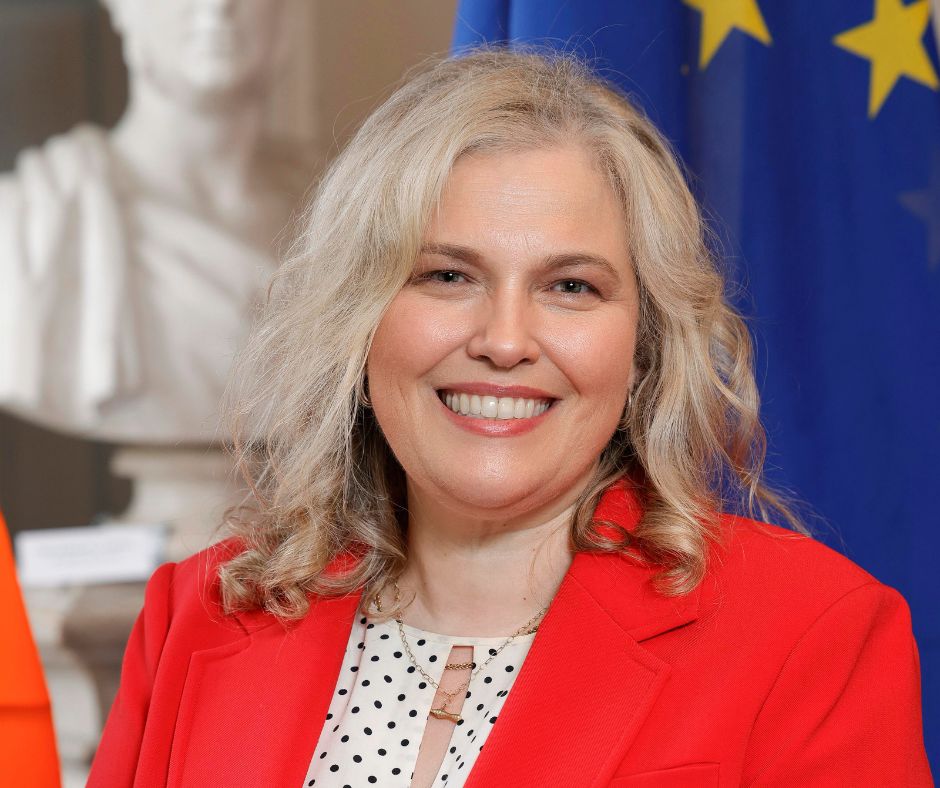
Noelle O'Connell is a Vice President of European Movement International and previously served as CEO of European Movement Ireland for almost 15 years, leading the organisation’s work during the last EU presidency, 3 European Parliament elections and the Brexit Referendum. Noelle is the founder of a new geopolitical, strategic counsel and communications advisory business.
Prior to her role in EM Ireland, Noelle worked in business development, public affairs, government relations, communications, member relations in a variety of sector and has managed several significant international funding projects.
Noelle is an experienced Director currently serving on the Commercial Advisory Board of Munster Rugby, chairs UCC’s International Alumni Advisory Board, is a nominee of the Taoiseach to the National Economic and Social Council, and is a member of the Co-Centre for Climate + Biodiversity + Water IAB. She previously served on the board of Alliance Française Irlande, and Skillnet Ireland. In 2017, was name a Knight of the National Order of Merit awarded by the French President and was appointed an International Leadership Fellow of Society of Leadership Fellows, St. George’s House, Windsor Castle. A member of the Institute of Directors, she is a Fellow of the Irish Institute of Training and Development and was shortlisted for the Newstalk WMB Social Entrepreneur of the Year and was appointed by the Irish government to be Ireland’s National Citizen Representative at the Conference of the Future of Europe. She regularly commentates on international political affairs and MC’s conferences and seminars nationally and internationally.
Noelle holds a BA Hons from University College Cork, a DEUF Diploma from Université de Jean Moulin, Lyon II France, an MSc in International Relations from the University of Edinburgh and Executive Business Finance & Strategy Innovation Diplomas from the IMI.