In this piece, Niamh O’Reilly, Executive Director of Learning and Education at the Institute of Directors Ireland, reflects on the importance of continuous learning in navigating an evolving business environment.
Dr Niamh O’Reilly brings a wealth of experience to her latest role as executive director of learning & education with the Institute of Directors (IoD) Ireland. She has served as chief of staff and a member of the executive leadership team at Maynooth University, Chief Executive of AONTAS, the National Adult Learning Organisation, and has held a range of senior governance positions, including board memberships of SOLAS and QQI. She currently serves on the Board of the Higher Education Authority (HEA).
Her new role brings together her long-standing involvement in governance and leadership with her deep interest in learning and development. “I have an unusual background, having served on boards for the last 15 years alongside my executive roles,” she said. “I have always been very interested in governance and have a deep understanding of its importance. I am also passionate about education and learning, particularly creating valuable learning experiences that draw on collective expertise. This role brings all of that together.”
As executive director of learning & education, O’Reilly oversees the full suite of IoD Ireland director educational offerings, including the Chartered Director Programme, workshops and bespoke board training.
O’Reilly believes director education is more important than ever. “We are living in a time of great uncertainty, when board members are responsible for making decisions with incomplete information,” she explained. “They must also contend with the impact of new technologies such as artificial intelligence (AI), geopolitical disruption and other factors. Our role is to help directors navigate that environment and keep pace with rapid change through the Chartered Director Programme, our other learning and education offerings, and our wider member resources and supports.”
The latest IoD Ireland director sentiment survey reveals an optimistic outlook despite these challenges with more than three-quarters (77 per cent) of participating directors expecting their businesses to grow in 2027.
“Directors are anticipating growth while navigating considerable change and uncertainty,” O’Reilly noted. “The survey gives us a clear steer on where our learning and education efforts need to focus. Strategy remains important, with 55 per cent of directors ranking it as the most important expertise their board will need over the next two years.”
The interplay between strategy, risk, governance, AI, digital transformation, cyber and culture, and how developments in one area shape decisions in another is particularly interesting, she added. “AI illustrates this well: almost 80 per cent of organisations are already using or experimenting with Gen AI, while only 24 per cent regularly consider AI as part of board discussions on strategy, risk and performance. This reinforces the opportunity for Learning & Education to help directors develop the breadth of knowledge, judgement and capability to understand these connections and apply them at board level.”
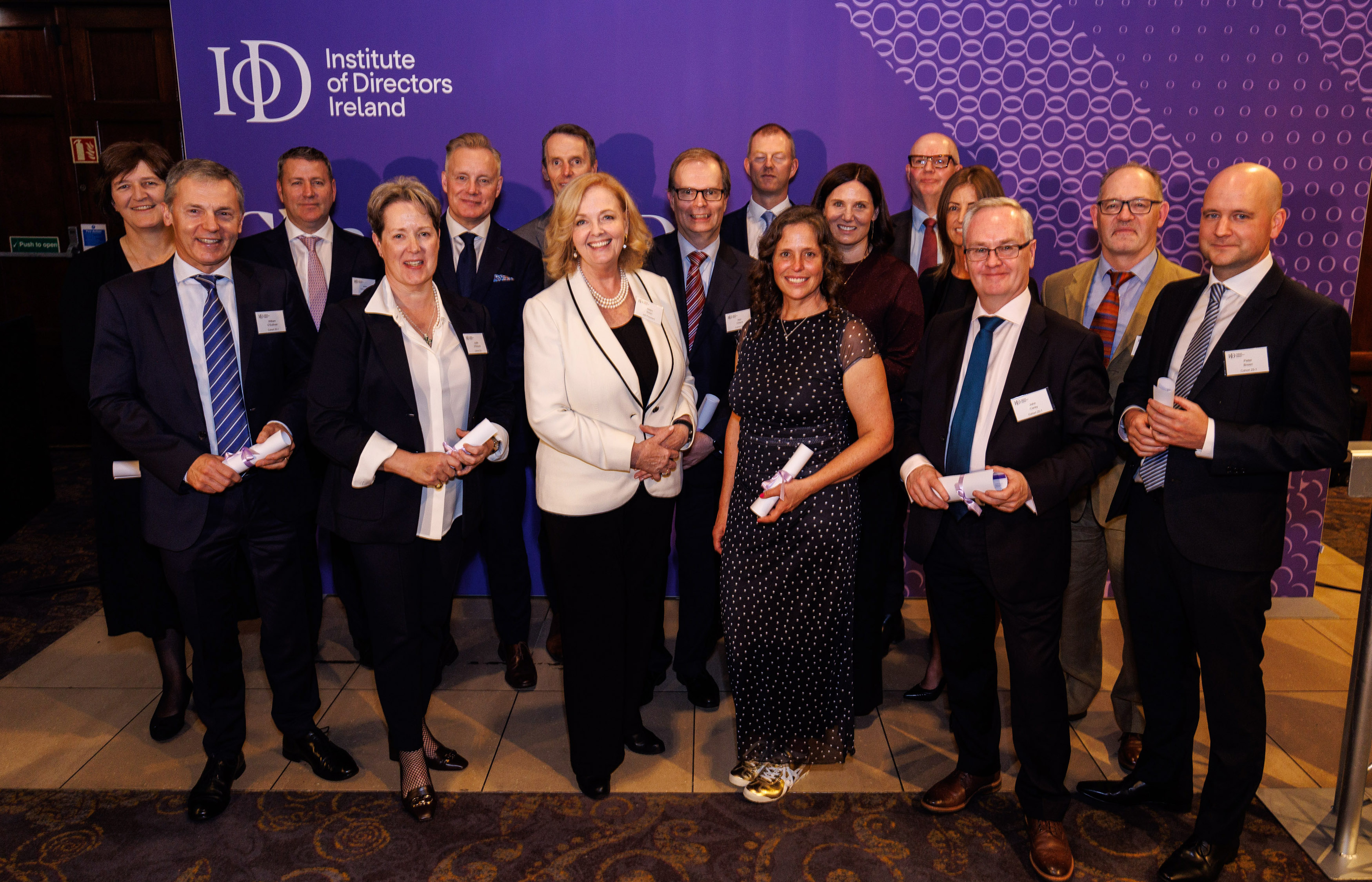
In this context, she pointed out that the IoD Chartered Director programme is the leading professional qualification for directors and the only such programme in Ireland that provides a complete pathway from Certificate in Company Direction, to Diploma in Company Direction, through to the internationally recognised Chartered Director (CDir) designation.
“The Chartered Director programme is unique,” she said. “It has proven its worth over many years when people who have done the programme speak about it, they describe it as the gold standard in director education. It combines practical learning, boardroom insight, assessment, and reflection to build capability and confidence. Part of what makes it unique is that it’s not one and done. When people become chartered directors, they remain actively engaged with the Institute and with one another, continuing to learn through the network and contributing their own experience for years to come.
The programme is also distinguished by who teaches on it and how. “Governance theory matters, but directors need to see how it plays out in a real boardroom. The programme operates at the intersection of theory and practice,” she said. “Our faculty are experienced executives and independent non-executive directors from across many sectors. They understand the practice and the theory and bring it together, that’s where the real value lies and it really resonates with people on the programme.”
Equally important is what participants bring themselves. “Our participants are experienced directors, senior executives and leaders from the private, public and not-for-profit sectors. A good educational experience is not just about transmitting information; it is about creating a reflective space where people can challenge each other, share what has worked and what has not, and learn from one another as well as from the faculty. The quality of that discussion, challenge and peer learning is one of the defining features of the programme.”
The benefits extend beyond the programme. “The qualification is just part of it. Graduates become part of an influential alumni network of board members and senior leaders who continue to contribute to governance and organisational leadership across Ireland and beyond. There is a real sense of community.”
Looking ahead, she sees director education continuing to grow in importance. “Our vision is for Ireland to be recognised as a global model of effective corporate governance, and education and learning and the Chartered Director programme in particular will be key to achieving that.”
About the Author

Dr Niamh O'Reilly is Executive Director of Learning & Education at the Institute of Directors Ireland. Niamh leads the organisation's learning and education function, including director education, professional development and governance programmes. She has over 20 years' executive leadership experience across higher education, adult learning and public policy, including as Chief of Staff and member of the Executive Leadership Team of Maynooth University and Chief Executive of AONTAS. An experienced board member and committee chair, she has served on the boards of SOLAS and QQI, including as Chair of the SOLAS Audit & Risk Committee. She currently serves on the Higher Education Authority (HEA) board and has previously served on the Senate of the National University of Ireland and the board of the European Association for the Education of Adults.
IoD Ireland Chartered Director Programme
Enrolment open for January 2027