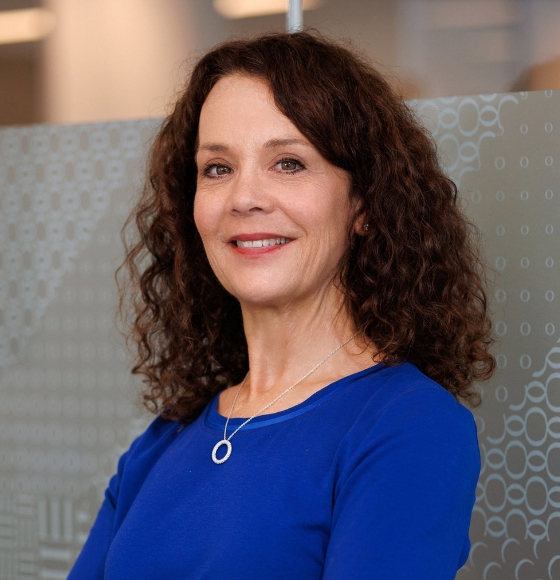
Yvonne Hill
Independent Non-Executive Director
Yvonne Hill is a highly experienced Independent Non-Executive Director and Audit & Risk Committee Chair, bringing considerable expertise in financial oversight, risk management and governance to regulated financial services boards.
After more than two decades in international insurance leadership, Yvonne Hill has successfully transitioned into a portfolio of independent non-executive directorships across banking and insurance. A Chartered Accountant, she currently serves on the boards of AIB Mortgage Bank and EBS, both part of AIB Group, as well as Zurich Life Insurance plc and AmTrust International Underwriters DAC
What first sparked your interest in board work?
I first became interested in board work while I was Finance Director with Canada Life. I was presenting regularly to audit committees and boards and began to realise that it was something I could see myself contributing to in the future. At that stage, it was more of a long-term ambition, but it definitely planted the seed.
Tell us a little about your early career journey.
I started my career with PwC after completing a BComm in UCD and a Professional Diploma in Accounting at Smurfit School. After qualifying as a chartered accountant, I moved to Kleinwort Benson in London before returning to Ireland to join Zurich. That was really where my long-term career in insurance began. I gained invaluable experience in running a busy finance function, budgeting, reporting, governance and statutory accounts. A later move to Canada Life broadened my perspective beyond finance into the wider commercial and actuarial side of the business, which was hugely valuable.
Your role at MetLife seems to have been a pivotal point in your career. What did that experience give you?
MetLife was transformational for me professionally. Over more than a decade, my responsibilities expanded significantly as the business grew internationally through acquisition. What began as responsibility for an Irish entity evolved into overseeing finance operations across 26 countries and 21 locations throughout EMEA. That kind of scale and complexity forces you to develop a much broader strategic and governance perspective. You are working across multiple jurisdictions, cultures and regulatory environments, which really shapes how you think as a leader. It also gave me significant board exposure. During my final years there, I served on several group company boards, which reinforced my interest in pursuing a non-executive portfolio career.
How did you prepare for the move into non-executive directorships?
I realised that if I wanted to pursue a portfolio career in the future, I needed to start preparing properly for it. That included joining IoD Ireland, undertaking director education programmes and seeking advice on how to position myself for board opportunities. Not long afterwards, an opportunity arose with AmTrust International Underwriters, while discussions were also progressing with AIB Group regarding subsidiary board roles. The timing and alignment with my experience gave me the confidence to make the transition.
Was stepping away from executive leadership a difficult decision?
Yes, absolutely. I genuinely loved my executive career and the people I worked with. What surprised me most initially was the pace difference. Executive life is constant interaction, decision-making and operational intensity. Non-executive work has a very different rhythm and structure. I also missed the day-to-day interaction with colleagues and teams. That constant exchange of ideas is something you really value in executive life.
What is the biggest mindset shift when moving into a board role?
One of the key adjustments is recognising that management runs the business, the board provides oversight, challenge and guidance. You need to resist the temptation to become operationally involved. Your role is to support and challenge constructively while allowing management to lead. That distinction is fundamental to effective governance. Boards are there to ensure the right questions are being asked, risks are understood and decisions are being properly considered.
You currently serve across several regulated boards. What skills are most important for INEDs today?
One of the biggest challenges for non-executive directors is staying current. Regulation, governance expectations and business environments are evolving constantly. Continuous learning is essential, particularly in areas such as cyber security, operational resilience and data governance, which are now core board responsibilities. Boards today are expected to understand not just financial and regulatory risk, but also how organisations respond to disruption, protect critical systems and manage third-party dependencies. For INEDs, staying relevant means being able to ask the right questions.
How important is ongoing director education and peer engagement?
It is hugely important. The value of director education, governance briefings and strong professional networks cannot be underestimated, particularly in helping directors keep pace with evolving expectations and governance best practice. That is one of the reasons organisations like IoD Ireland play such an important role for directors at every stage of their board career.
In your view, what makes an effective board?
Diversity of thought is critical, and Boards need a diversity of skills, experience, background and perspective. Without that, there is always a risk of groupthink. Strong chairing is equally important. An effective chair creates an environment where discussions remain focused and constructive, while ensuring there is space for differing views and healthy challenge. Ultimately, the best boards combine strong oversight with strong relationships. There needs to be trust, but also the confidence to challenge appropriately when needed.
What advice would you give to aspiring non-executive directors?
Firstly, understand what board life actually involves, particularly in regulated sectors where the level of preparation and oversight required can be significant. Secondly, start building board readiness early, through governance education, committee exposure and broad strategic experience. Most importantly, be very clear on the expertise and perspective you bring to a board and how that aligns with what an organisation needs. That alignment is fundamental to being an effective director.