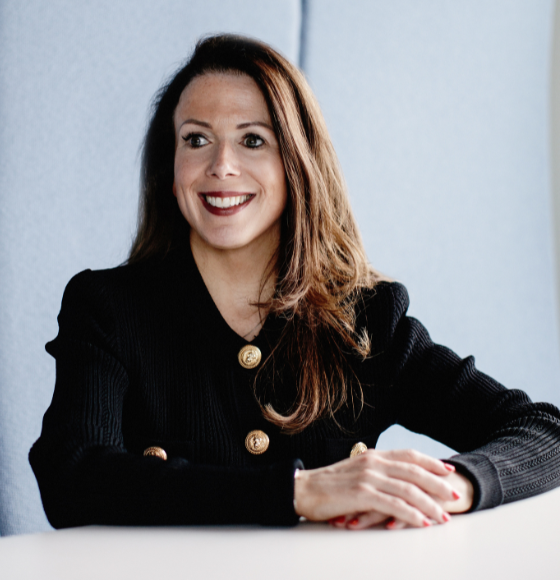
Vanessa Hartley
Head of Google Ireland
Vanessa Hartley is Head of Google Ireland, and has extensive senior leadership experience across EMEA, including leading Google’s large customer sales teams. She has also held senior commercial and marketing roles at GloHealth and Aviva Ireland.
Your career journey spans financial services, health insurance and now senior global leadership at Google. Looking back, was there a turning point or opportunity that really accelerated your career - and what made you say yes to it?
I’ve been fortunate to have had many great opportunities throughout my career. Before joining Google, my experience spanned marketing, product strategy, and operations across several leading organisations, including Halifax, Aviva, GloHealth, and Permanent TSB. This year marks my 12th year at Google. I joined the company pregnant with my second child. My instinct and a gentle nudge from my husband told me to take the chance, even though I knew it would be a challenge with two children under two. Over the past decade, I’ve had a front-row seat to profound shifts in how businesses grow, from the global transition to mobile to the transformative potential we’re now seeing with generative AI. At Google, you grow through the organisation by taking on responsibilities beyond your existing role. My development and success have been linked to identifying ways to solve and scale our most complex global challenges with exceptional people. Collaborating with such talented, curious, and mission-driven colleagues has challenged and supported me in equal measure, consistently shaping and changing who I am as a leader.
You’ve worked across different sectors and countries, what has that variety taught you about yourself as a leader?
I’ve learned that in a rapidly evolving world, the role of a leader has shifted from being the expert with all the answers to someone who leads with curiosity and makes sense of the data. Whether in financial services, healthcare, or global tech, my role is to look for the signals and patterns in the data and help my team focus their energy on the biggest problems to solve or opportunities to address. Working across diverse sectors, cultures and countries has made me comfortable navigating complexity; it forced me to look at the whole business rather than just a single function. While the environments change, the leadership fundamentals - clarity, empowerment and resilience - remain universal. These experiences have shaped the leader I aspire to be, someone who values diverse perspectives, stays curious, and creates an environment where teams can cut through the noise to deliver truly meaningful outcomes.
As Head of Google Ireland, what opportunities and strengths do you see in Ireland as a place to lead and grow a business today?
Ireland has never been a country that waits for change to happen; we are a nation that makes things happen through partnership. I see our strength today sitting in three specific areas:
First, our "Both/And" economy. We often frame our success as a choice between Foreign Direct Investment (FDI) or homegrown innovation, but Ireland’s real edge is that we have both. We have a global technological hub sitting alongside a vibrant indigenous startup scene. That ecosystem creates a unique reflex for collaboration that you don't find elsewhere.
Second, our agile talent. Ireland currently has the highest rate of third-level education in the EU for 25-34 year olds. But what really sets us apart isn't just the degrees, it’s our adaptability. We have a workforce that can pivot as technology accelerates. This is crucial because by 2030, over a quarter of our workforce will be Gen Z. This group will have grown up in the AI era as AI-natives. They won't just have used these tools; they will have defined them.
Third, and most importantly, it’s that 'roll up your sleeves' attitude. I come from a family of farmers and educators, and I know that when we work together, there is no challenge we can’t solve.
When you bring these three things together, our unique ecosystem, our talented people, and that pragmatic Irish spirit, the potential is staggering. We are already at the forefront of the next wave of digital transformation, and Ireland has both the skills and the relationships to lead. This is our once-in-a-generation opportunity to ensure technology works for every person, in every part of Irish society. In my role I feel a profound sense of responsibility to ensure Google AI is for everyone in Ireland.
You’ve held Go-To-Market and central operations leadership roles, from your perspective, what most often causes strategy execution to fail in large organisations?
One of my core beliefs is “Brilliant strategy is nothing without brilliant execution”. I tend to spend a lot of time in the pre-mortem phase of execution planning. I've observed that execution challenges are often a disconnect between high-level strategy and clear outcomes. To bridge this, I spend a lot of time with my teams upfront aligning on what a successful end state looks like. I ensure every stakeholder clearly understands the opportunity and their individual role in driving the outcome. Most importantly, clear communication plans underpin all strategy and change management.
From where you sit, what do boards most misunderstand about the pace and practical impact of AI and digital transformation on their businesses?
One misunderstanding is viewing AI as a fragmented tool for efficiency rather than a foundational rewiring of how a business operates. Our recent research with Amárach shows a 'confidence and capability gap' in Ireland: while 80% of SMEs believe AI will have a positive impact, only 6% have made it central to their operations. For boards, the takeaway is clear: the barrier isn't the technology, but the infrastructure around it. A description from one of my colleagues at Google Deepmind which has always stuck with me is “Just as the industrial age required redesigning the factory rather than just swapping the steam engine, AI requires a total reimagining of organisational systems. It is not an IT line item; it is a structural evolution.” I saw this in action recently at the Scale Ireland Regional Summit in Cork. I spoke with founders who have completely pivoted to be 'AI-driven,' developing world-class agentic solutions right here in Ireland.
How should boards challenge management teams differently when technology change cycles are measured in months rather than years?
The shift suggests a move from being guardians of a long-term plan to leading with agility. In my current board roles, I’ve definitely seen a pivot away from static, multi-year roadmaps toward the ability to adapt in real time to the shifting data signals. As leaders, we can add value by probing the speed of the feedback loop rather than just the output. It’s about challenging management to prioritise rapid iteration, moving from a culture of "certainty" to one that is comfortable navigating the unknown. Our role is to ensure the organisation is built to learn as fast as the market is moving.
You’ve built and led high-performing commercial teams - what are the non-negotiables you look for in senior leaders and what leadership capabilities do you think will matter most over the next five years?
The most complex challenges require leaders who can break down silos, bring different perspectives together, and align teams around a shared goal. These leaders will typically have strong systems thinking abilities - the capacity to architect an opportunity for global scale considering the process, people and systems implications. They’ll be able to use their judgement to make decisions, sometimes under pressure, that will stand the test of time. A point of difference for some of the best leaders I have worked both for and with is their approach to communication. They aren't just broadcasters; they are the people who really take time to build trust, listen and learn from those at every level of the company. They will care deeply about their teams, their customers and their responsibility in this AI era. Being self-reflective and a lifelong learner is also essential - I personally commit to trying to get 1% better every day. I need to be user number one of both Google's and our competitors’ AI.
Are there any personal leadership habits or routines that help you stay effective and focused in a fast-moving environment?
I’m a huge believer in high intensity outcome-focused work and also ensuring I rest and have fun with my friends and family. I am very intentional about where I spend my time inside and outside of work - that ensures I get the balance right (mostly) between my work and my kids and my friends. I don’t get half involved in things, but rather have a really clear line with my husband and team in work on what I’ll do or not. I think this is particularly important for women executives who can get caught up in the social narrative of needing to “do it all”. For me I’ve learned to do the things that are really important to me, as well as I can and not worry about the things that aren’t. I read compulsively: fiction, non-fiction, memoirs, and I walk daily and enjoy a sea swim!
For current and aspiring directors, how valuable is it to be part of a professional body like the IoD Ireland and how can membership support better leadership and decision-making?
Being part of a professional body like IoD Ireland connects leaders with a strong network of experienced directors and business leaders across Ireland. That community is invaluable for mentorship and gaining diverse perspectives. Exposure to different industries and viewpoints helps leaders step back from day-to-day challenges, think more strategically, and guide their organisations with a clearer long-term vision.