Seán O’Neill CDir
Director, TWM
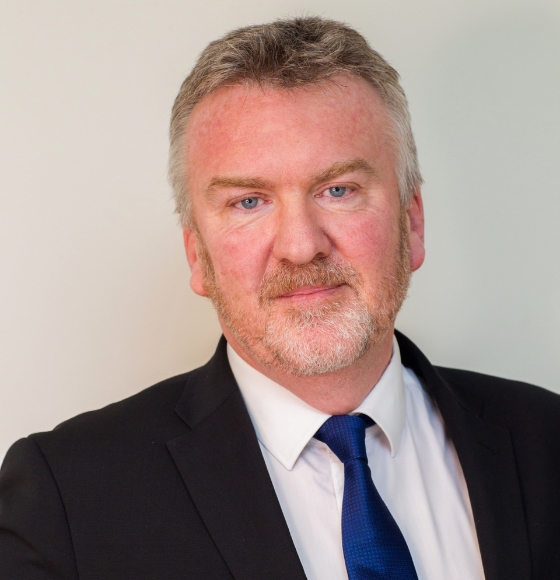
Seán O’Neill CDir is a property investment and asset management specialist with 38 years’ experience advising leading organisations and investors on complex real estate strategies, major transactions and long-term portfolio performance.
With 38 years’ experience in Ireland’s property industry, Seán O’Neill has built a career advising major organisations and investors on complex real estate decisions. As a Director at TWM, now part of ORS, he specialises in property investment and strategic asset management, working with clients including Tesco Ireland, An Post and international real estate investors such as AM alpha. His experience spans some of the country’s most significant retail and commercial property transactions, requiring commercial judgement, long-term thinking and a clear understanding of how property supports wider organisational strategy.
To begin, Seán, tell us about your background and the career path that led you to your current role.
I graduated in 1988 with a Diploma in Property Economics from DIT and a B.Sc. (Surv.) from Trinity College Dublin, before beginning my career with JLW, now JLL. Over the following years, I built extensive experience across the commercial property sector, holding senior roles with firms including NCB, Palmer McCormack and Lambert Smith Hampton. In 2003, I co-founded a real estate advisory business, which was successfully sold to DTZ Sherry FitzGerald the following year. As part of the acquisition, I joined the senior executive team. I completed MBA and received a MSc (Management) degree from Trinity College Dublin in 2008. Following the financial crisis, I founded O'Neill Strategic Property Advice in 2010, a business that became TWM and established itself as a trusted property advisory firm. Most recently, with my co-owner Michele Jackson, we successfully completed the sale of TWM to the ORS Group.
TWM has been advising clients for more than 15 years. How has the business evolved, and what opportunities do you see for the company in the years ahead?
I set up the business in 2010 after the financial crash with a simple objective: provide clients with independent, trusted advice tailored to their specific needs. A very strong client focus was always at the very centre of everything we do. Our aim has always been to offer clients the services that they need to succeed. We set up an internal team with a specific focus on client portfolios to try to identify opportunities for clients to maximise value. The recent sale of TWM to ORS has further strengthened this and represents an exciting new chapter. It allows us to offer our clients access to a truly multidisciplinary real estate platform with nationwide reach. In considering the sale of the business, we wanted to ensure that it remained a long-term, sustainable business for all, including employees and clients, while maintaining the same culture and values. We did not want to be absorbed and disappear. The partnership with ORS achieves this and creates significant growth opportunities for all stakeholders.
You've held leadership roles across the private sector and now chair the Cappagh Hospital Foundation. How has your perspective on governance evolved throughout your career?
If you want to build a sustainable organisation, whether in the private, public or charitable sector, strong governance and high ethical standards are non-negotiable. My views on this haven’t changed; however, the processes to ensure that this happens have probably evolved. Although TWM is a relatively small business, our senior team came from large corporate environments. We set out to adopt big firm processes and governance with small firm flexibility and outlook. Integrity appears in almost every company’s values and there is a reason for that: it matters. Good governance is how you turn those values into action. I brought the same approach to Cappagh Hospital Foundation, where we placed strong governance, compliance and transparency at the centre of everything we do. We recruited board members with a strong experience bias towards compliance and governance, so our processes are very strong in that regard. Donors need confidence that their contributions are managed responsibly and are making a real difference.
What do you believe distinguishes a high-performing board?
Diversity, to encourage differing opinions and healthy debate; expertise and energy, to promote innovation and forward momentum; and respect and experience, to build trusted leaders who lead from the front and provide a consistent guiding light for the organisation.
Beyond governance and oversight, what role do you believe boards should play in shaping organisational culture and long-term sustainability?
Teams need leadership and clarity: an overall plan which can be easily understood and believed by all. The most successful teams may not always have the best players but will have a shared vision and plan of action with everyone knowing what they have to do. Success rarely happens by accident. In the recent FIFA World Cup, you saw weaker teams perform beyond expectations when they had this shared belief and plan. The Irish soccer team under Jack Charlton was a prime example of this also. In my view, the board must provide leadership through clarity: clarity on the vision for the company, why it exists and how it will create long-term value. The board should also provide cultural leadership through example. Its culture and values will help determine how that value is achieved.
Many organisations are navigating significant change. In your experience, what role should boards play in leading through uncertainty while maintaining stakeholder confidence?
All stakeholders will want to see that the Board has the uncertainty under control and has a plan to deal with it. The Board should lead collectively, decisively and with confidence. The organisation's values, ethics and internal processes should remain its touchstone. One of the biggest impacts I saw during Covid, particularly the initial lockdown period, was communication: letting stakeholders know what was happening, what solutions were being put in place and that everything was under control. Stakeholders don’t expect leaders to have all the answers immediately, but they do expect honest, timely and consistent communication.
The role of boards continues to evolve in response to changing stakeholder expectations, regulation and risk. What do you see as the biggest governance challenge facing boards today?
I think the use of AI will provide one of the biggest challenges. Knowing what to believe, and ensuring that the advice being provided is well researched and can be relied upon, is key. AI can be a fantastic tool, particularly in relation to efficiency, but there are still many pitfalls and unknowns. We see AI being used frequently for research, summaries of documents and reports etc. However, as this happens, judgement becomes even more important. Experience, scepticism and robust governance frameworks will be essential to ensure decisions remain evidence-based and reliable. While embracing AI, boards must ensure standards are not compromised.
Looking back over your career, is there a governance lesson or boardroom experience that has had a lasting influence on your approach to leadership?
The financial crash and its aftermath had a lasting impact on my thinking. It underlined the importance of strict standards of governance. In a crisis, and indeed in a boom, it can be easy to let standards drop. However, if high standards are a habit, then you default to type when under pressure. In this regard, I particularly like the Aristotle quote: “We are what we repeatedly do. Excellence, therefore, is not an act but a habit”. A lot of large companies let their standards slip during the boom. As Warren Buffett said, “Only when the tide goes out do you discover who has been swimming naked.” Following the crash, transparency and trust became paramount. Institutions such as NAMA needed advisors that they could trust and not be conflicted in their advice. Property owners and borrowers needed advisors that were trustworthy and discreet. All stakeholders saw the downside front and centre at that time. We have had a number of crises since then; however, the lessons learned from the crash have stuck with me. Ultimately, our reputation is our most valuable asset.
What motivated you to undertake the Chartered Director Programme, and what impact has the Chartered Director (CDir) designation had on your effectiveness as a board member and Chair?
A few years ago, my co-owner, Michele Jackson CDir, and I felt we were at a crossroads with the business. We both enrolled and undertook the programme at the same time, although in different classes. The Programme gave us a fresh perspective, sharpened our strategic thinking and allowed us to take a step back to see what we could do better and provide some self-reflection. Following the Programme, we engaged external advisors to help us build a strategy and vision for the future and recruited a respected industry leader, Willie Norse, as Managing Director, to lead day-to-day operations. This allowed us to focus more on growth and strategic development. As regards my role as Chair, the programme also deepened my appreciation for Board composition and the importance of diversity of experience, expertise and perspective.
What value has your membership of the Institute of Directors brought to you, both professionally and personally?
IoD membership has broadened my perspective significantly. It has opened my eyes to the world of business beyond real estate and to see business challenges through different lenses. It has also changed how I view real estate, not simply as an investment asset but as a strategic tool that can enhance culture, productivity, brand and overall business performance. On a personal level, it has encouraged reflection on my own values, leadership approach and how I can contribute more effectively to organisations and communities in the future.
When you're away from the boardroom, what helps you maintain perspective and make better decisions as a leader?
I learn a great deal from conversations with business leaders and from studying elite sports teams. I also host The TWM Real Estate Podcast, where I speak with people from across the real estate sector. Those conversations expose me to different perspectives on property, leadership and long-term decision-making. I am fascinated by what businesses can learn from successful teams on the sports field. I read a lot of autobiographies and books on team culture, leadership and performance. One book that had an impact on me was Clive Woodward’s Winning. His relentless focus on vision, preparation, marginal gains and continuous improvement demonstrated how small, consistent improvements can produce extraordinary results over time. The lesson applies equally to business. Sustainable success rarely comes from one big decision. More often, it’s the result of clear direction, disciplined execution and a commitment to getting the small things right every day.