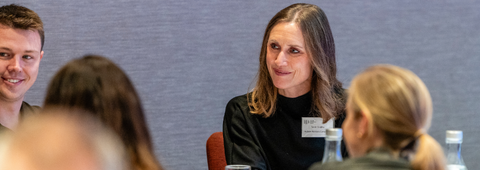
Noelle Condon FCA
Independent Non-Executive Director
Noelle Condon FCA is an experienced non-executive director and former NAMA CFO, with extensive expertise in finance, regulation, governance, audit and risk management. She brings significant board and committee experience across financial services, public bodies and not-for-profit organisations.
Your time as CFO of NAMA has now concluded. What did that chapter involve, and what do you take into your current Board work?
NAMA was a challenging and absorbing chapter of my career. As CFO, my role covered Finance, Audit & Risk, Operations, Systems and Tax. I served on NAMA’s Credit, Risk Management and Finance & Operating Committees, worked closely with the Board and Audit Committee, and led a multidisciplinary team through the final years of the Agency’s mandate. There was a lot to balance: commercial objectives, public policy, public accountability and the expectations of different stakeholders. NAMA facilitated tens of thousands of new homes, supported major regeneration projects in Dublin Docklands and Poolbeg, repaid the €31.8bn of debt issued to acquire its loan portfolio and delivered a €5.6bn lifetime contribution to the State. The experience showed me the importance of strong governance and careful judgement in a highly scrutinised environment. It also shaped how I approach Board work: decisions need to support strategy, risks need to be understood and accountability needs to be clear. That works best when there is trust between the Board and management.
How has your CFO experience shaped the judgement you bring to Board decisions?
As CFO, I learned that strong performance depends as much on governance, culture and risk management as it does on financial results. During NAMA’s wind-down, we reshaped structures and accountabilities, brought some outsourced work in-house and maintained a strong control environment. Sustaining culture through that change mattered too. We kept communication open through town halls and one-to-one conversations while helping colleagues consider their next steps and development needs. At the same time, the risk landscape was evolving. Cyber security became an increasingly important Board issue, and we introduced additional monitoring and awareness measures. We also began exploring how automation and emerging AI tools could improve efficiency and resilience while ensuring appropriate governance, controls and oversight remained in place. I learned that change has to stay connected to strategy. Its impact on risk, culture, technology and the organisation’s ability to deliver all need to be considered together.
What makes the relationship between a Board and management effective?
To me, trust is the most important part of the relationship between a Board and management, and good communication is how that trust is built and maintained. As CFO, I worked closely with NAMA’s Board and Audit Committee. I valued directors who came prepared, asked clear questions and gave management room to explain the context, options and constraints. That experience informs how I approach my role as a director. In my experience, an effective Board keeps the organisation’s purpose and objectives in view. It tests significant proposals against strategy, underlying assumptions and risk appetite. As a director, I listen carefully to understand management’s reasoning and ask for clarity where I cannot see the connection to strategy, risk or the organisation’s ability to deliver. For me, this is where trust and challenge go together. Management needs to be able to raise difficult issues early. I see the Board’s role as providing direction and oversight, offering support and constructive challenge, and making accountability clear while respecting management’s responsibility for delivery.
How have your charity and public-service governance roles shaped your approach?
During my five years as Chair of CRY Ireland, I worked with trustees to keep our decisions focused on the charity’s mission and the people it supports. I saw how much good governance depends on the way a Board works: trustees need clear information, the right skills and a shared understanding of their responsibilities. We worked on those foundations through trustee development, clearer Board reporting and a review of how the Board was working. We also ran an open process for Chair succession and developed CRY’s 2025–30 strategy. I found that this helped the Board stay focused on its priorities and make better decisions. I bring the same approach to my role as an external member of Tusla’s Audit & Risk Committee: seeking clear assurance, asking thoughtful questions and keeping accountability connected to the organisation’s purpose.
How did you prepare for non-executive work, and what has the Chartered Director programme contributed?
I started the Chartered Director Programme while I was CFO, as I prepared to move from executive responsibility into non-executive work. I already had Board experience and wanted to build on it. The programme gave me a clearer framework for the director’s role and helped me understand how strategy, governance and boardroom dynamics come together. It also prompted me to think about how to bring my executive experience into Board discussions while retaining independent judgement: stepping back, looking at the organisation as a whole and asking strategic questions. The cohort has been one of the best parts of the programme. Learning with directors from different backgrounds has broadened my perspective and given me a trusted sounding board. The friendships have been an unexpected and lasting benefit.
As you build the next stage of your Board career, where could your experience add the greatest value?
I believe I can add most value to Boards facing significant investment or financial decisions, or periods of strategic change. My experience spans banking, NAMA, commercial property, credit-union governance and public service. It has given me a strong grounding in financial stewardship and risk, and a practical understanding of what it takes to turn a decision into delivery. As a director, I bring independent judgement to Board decisions and ask whether the financial case is sound, the risks are understood and the organisation can deliver. I am building my Board portfolio around organisations where that experience fits the Board’s priorities.