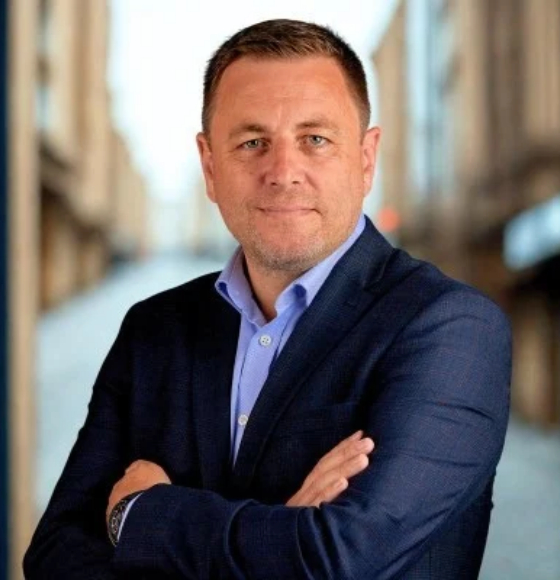
Mark McDermott
Founder and CEO, Nuapoint
Mark McDermott is an international business leader and adviser with extensive experience across technology, revenue growth and market expansion. Having held senior roles with Microsoft and LinkedIn, he now advises organisations on growth, collaboration and strategy, while supporting initiatives shaping Dublin's future development.
Your career has spanned Microsoft, LinkedIn and, more recently, entrepreneurship. Which experiences have most shaped your approach to leadership?
Microsoft taught me to connect technology to a business outcome. LinkedIn taught me where those outcomes begin. I was the first Dublin hire for an initiative serving LinkedIn’s largest global clients across every business line. We were creating a new go-to-market model while delivering it, which sometimes felt like living in a house while renovating it. The first indication that the model was working came through our measure of client satisfaction. Clients were telling us that they preferred a more joined-up relationship with LinkedIn. Revenue growth followed, with the international team I led ultimately responsible for over $100m in annual revenue. That sequence shaped my approach to leadership. Stronger commercial results began with a better understanding of the people we were trying to help. Whether you are working with clients or colleagues, the starting point is to understand what success means to them. You can then bring the operational intelligence, evidence and delivery needed to help achieve it.
What prompted you to move from leading within major global organisations to establishing your own business?
After working inside large international companies, I became interested in the challenges businesses face when they try to enter a new market without the infrastructure, relationships or local knowledge available to a global organisation. I established Nuapoint initially to help US companies understand Ireland and Europe, build the right relationships and develop a practical route into the market. Over time, I saw the same challenge in reverse. Irish companies could find plenty of general advice about the US, but it was harder to find experienced people prepared to help them test their proposition and build a market. That experience has reinforced something I learned earlier in my career: ambition needs to be supported by evidence. Before making a major investment, a company should know whether its proposition resonates with decision-makers in the market, whether the problem it addresses is sufficiently important and whether customers are genuinely prepared to change. Sometimes the most valuable conclusion is that the evidence is not yet strong enough. Discovering that early can prevent a company from making a much more expensive mistake later.
What have you learned about how Irish companies can establish credibility and build trust in the US?
Irish leaders often arrive focused on their product, the introductions they can secure and the speed at which they want to progress. US buyers are more interested in whether you understand their business and the particular problem they need to solve. Credibility earned in Ireland may help secure an initial meeting, but trust must still be built locally. That requires listening, understanding the commercial context and demonstrating that you can deliver in that market. Boards must also distinguish between genuine geopolitical or regulatory risk and personal reactions to a particular political administration. Trade policy, regulation and political uncertainty clearly belong in a market-entry assessment. Personal political preferences should not replace commercial judgement. Engaging with the US market does not amount to endorsing its government. Ireland has considerable experience of maintaining valuable commercial relationships while remaining clear about its own values.
What evidence should a board seek before committing significant resources to US expansion?
The first evidence should come from meaningful conversations in the market with people who understand the relevant sector and are active within it. Those conversations should help the board understand who will buy the company’s product or service, why they would buy it and whether the problem being addressed is important enough to prompt a change in behaviour. Boards should also resist treating the US as a single, uniform market. Economic conditions, regulation, sectoral clusters and routes to market can vary significantly between states and regions. The most appropriate entry point may not be the most obvious or best-known location. A staged approach allows the organisation to test its assumptions, develop relationships and gather evidence before making a substantial investment in people or infrastructure. A board should be able to see clearly what has been tested, what has been learned and what would need to be true for the next stage of investment to be justified.
As technology reshapes established business models, how can boards create space for innovation without losing appropriate oversight?
One of the most significant risks facing boards is the potential displacement of an established business model, particularly as artificial intelligence changes how organisations create and deliver value. Selecting emerging companies for Unicorn Hunters, the investment-focused television series featuring Steve Wozniak and Rosie Rios, gave me firsthand exposure to the creativity and commercial ambition of entrepreneurs. Large companies frequently say they want that kind of innovation, but their internal systems often reward process, predictability and conformity. Original thinkers can find themselves gradually managed back towards the norm. Boards should consider whether the organisation genuinely creates space for experimentation and constructive challenge. They should ask which assumptions underpin the existing business model, whether those assumptions remain valid and where new technology could materially change the organisation’s relevance to its customers. Oversight remains essential, but it should help the organisation innovate responsibly rather than discourage it from trying anything unfamiliar. The challenge is to create clear boundaries around experimentation while remaining open to ideas that could challenge established ways of working. People who can innovate from within an organisation -true intrapreneurs - will become increasingly valuable. Boards should ask whether their culture allows those people to be heard and whether management has the capacity to act on their ideas.
You have been invited to convene work towards YES/Dublin. What have you learned about the leadership required to bring business, government and academia together around shared challenges?
My work in San Francisco brought me into contact with the World Economic Forum, which subsequently asked me to convene work towards YES/Dublin. The Forum brings together people from different disciplines to consider difficult problems as interconnected systems. That way of thinking appeals to me because many of the challenges facing Dublin cannot be addressed effectively by any one organisation or sector. Cities provide a practical lens through which to understand an economy. They bring together people, businesses, public institutions, infrastructure and many of the social and economic challenges that need to be solved. If Dublin functions better, Ireland benefits. The difficulty is that business, government and academia can sometimes talk at one another rather than work together. Convening people is only valuable if it helps them reach a shared understanding of the problem, recognise their respective responsibilities and agree on practical action. Leadership in that setting is not about having every answer. It is about involving the right people, building sufficient trust for an honest conversation and maintaining momentum after the initial discussion. Dublin must also become better at connecting local innovation with the organisations capable of adopting it, while remaining open to ideas and solutions from elsewhere. A city’s ability to connect its institutions and harness innovation is an important part of its long-term economic resilience.
What role could the Irish diaspora play in Ireland’s future economic development and international reach?
Ireland’s diaspora is an enormously valuable but still underused resource. Its contribution is strongest when relationships are active, organised and mutually beneficial rather than called upon only when something is needed. I attended the Global Irish Civic Forum in Croke Park earlier this year, where the Government launched its new diaspora strategy. I welcomed its recognition that Ireland’s relationship with its diaspora must work in both directions: supporting Irish communities abroad while also creating opportunities for them to contribute to Ireland. My involvement with the San Francisco GAA Western Division has shown me how influential the Irish community can be when it is connected. It has reach across business, construction and civic life throughout the Bay Area. I am also advising the United Irish Cultural Center during an important phase in its development. It has the potential to become an even stronger connecting institution between Ireland and Silicon Valley. The diaspora brings together commercial experience, trusted relationships, local knowledge and a strong connection with Ireland. If we organise and support those relationships effectively, they can help Irish companies understand new markets, avoid costly mistakes and establish credibility more quickly.
At important inflection points, what questions should leadership teams and boards be willing to ask themselves?
They should begin by asking what has changed and whether the assumptions underpinning the current strategy are still valid. They should identify the people who understand the problem most clearly, including those closest to customers, employees and delivery. They should also consider whose perspective is missing from the discussion and whether hierarchy or established ways of working are preventing important information from reaching the board. Another important question is whether the organisation is solving the right problem. Companies can invest considerable time and resources in improving an existing approach without stepping back to consider whether a fundamentally different direction is now required. At an inflection point, the role of leadership is to widen the available options, test assumptions and create enough trust for people to say what they genuinely think. The eventual decision must still be practical, evidence-based and capable of being delivered.
What is the most valuable piece of leadership advice you have received?
My late father, Fergus, often said: “This too shall pass.” It sounds like spiritual advice, but in leadership it is also very practical. Under pressure, a difficult moment can take over your thinking. The phrase reminds me to pause, recognise what is driving my response and make a decision I can stand over later. The moment will pass; the consequences of the decision may not. Good periods pass too, so the advice is also a reminder to remain grounded. Leadership requires perspective in both success and difficulty.
What prompted you to join IoD Ireland, and how has membership influenced your approach to leadership and governance?
I joined IoD Ireland after establishing Nuapoint. Moving from a large organisation into entrepreneurship reinforced the value of having access to experienced peers who bring different sectoral, leadership and governance perspectives. Through IoD Ireland, I have met directors who are generous in sharing their experience and willing to challenge one another’s thinking. Those conversations have encouraged me to look beyond the immediate commercial decision and consider the quality of the evidence, governance and stakeholder relationships supporting it. I particularly value being part of a community that recognises that good leadership requires continuous learning. Experience provides an important foundation, but directors and senior leaders must remain open to new perspectives as technology, markets and societal expectations change.