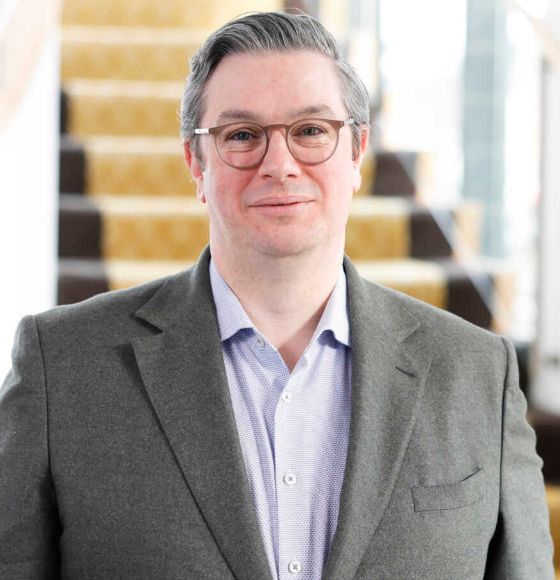
Kevin McPartlan
Chief Executive Officer, Fuels for Ireland
Kevin McPartlan is Chief Executive Officer at Fuels for Ireland. He works at the intersection of business, regulation and national infrastructure. Representing companies that supply more than half of Ireland’s energy, he operates in a sector under constant scrutiny and change.
Your career has spanned communications, consumer sectors, advocacy and now energy. What themes connect each chapter?
My academic background is in law, and I started my career in communications, where the focus was on shaping arguments and influencing outcomes. Over time, I came to understand that communications on its own is limited. You can only go so far telling a story if the substance behind it is weak. Credibility depends on what sits underneath the message. That led me into broader leadership roles. The shift was from telling a story that had already been written, to being involved in deciding what the story actually is, what position we take, what we stand over, and what we are asking others to accept.
Across all of that, one thing has been consistent. I try to be very clear about what success looks like and to stay focused on that. It’s easy to get drawn into detail or into defending positions. The more important question is always whether you are moving closer to the outcome you are trying to achieve.
As CEO of Fuels for Ireland, what does leadership look like in the energy sector?
It’s not traditional leadership. I’m not running a company with a single executive team. I report to a Council made up of the senior leaders of ten large businesses, each with their own strategies, priorities and commercial realities. My job is to bring those together into a position that is coherent and credible, both internally and externally. Those individuals are very strong commercial leaders, but their focus is not primarily on the policy environment. A large part of my role is to interpret that environment, to understand how regulation and public policy will affect their businesses, and to help shape it in a way that allows them to operate effectively. That means challenging people. It means asking them to look beyond their immediate position and to engage with the direction of travel, particularly in the context of the energy transition. You won’t always get full agreement, but you need to get to a position that can stand up. Externally, it comes down to credibility. We operate in a contested space. If you are not credible, you are not effective.
In stakeholder-heavy environments, how do you build trust while still driving outcomes?
There is no shortcut to it. It comes down to credibility over time. You have to be reliable in what you say. The information you provide needs to be accurate. The arguments you make need to be grounded in evidence. If you try to spin things, you might get a short-term win, but you will lose trust, and that is very hard to rebuild. An important part of that is how you deal with mistakes. Everyone gets things wrong at times. The key is that you are the one who points it out. If you’ve given someone incorrect information, you go back and correct it. If they find out from someone else, your credibility takes a hit. If you are consistent in how you behave, people learn that they can rely on you. That gives you access, and it allows you to have more direct and more useful conversations.
What distinguishes high-performing boards from ineffective ones?
The best boards are very clear about what their role is. They are there to set direction, to oversee risk and performance, and to hold the executive to account. They are not there to run the business. Where boards struggle is when they drift into operational detail. It can feel productive, but it isn’t. It distracts from the real job. A good board is disciplined. It focuses on the right level of issues. It supports management, but it also challenges them, and that challenge has to be constructive. The tone in the room matters as well. If there is trust, people will speak openly, including about problems and mistakes. Without that, you get guarded conversations and weaker decisions.
What conversations should boards be prioritising now that they often are not?
Boards are very comfortable approving strategy and setting targets. They are less comfortable interrogating how those targets will actually be delivered. The key question is: how? Do we have the capability, the people, the systems and the resources to do what we are saying we will do? And if we don’t, what are we going to change? Boards also need to spend more time looking outside the organisation. It is easy to become focused on internal reports and performance. But external factors, regulation, economic conditions, public expectations, can have a far greater impact. At a basic level, boards should be asking: is this deliverable? And if we’re not sure, why not?
What does good governance look like in practice?
It starts before the meeting. Directors need to have a clear understanding of the organisation’s purpose and objectives. Without that, it is very difficult to make consistent decisions. Preparation is also fundamental. People need to come into the room having read the material and thought about it. Otherwise, the meeting becomes a process of information-sharing rather than decision-making. In the room, it should not be performative. It’s not about who speaks the most or who sounds the most authoritative. It’s about getting to the right answer. That requires trust. Directors need to be willing to challenge each other and to be challenged. The executive needs to be able to speak openly about what is going well and what is not. If those conditions are there, the board will generally make good decisions. If they are not, the structures on paper won’t compensate for it.
What major shifts do you believe Irish business leaders need to prepare for?
The external environment is becoming more complex and more intrusive into how businesses operate. Regulation and public policy are now central to many sectors, not peripheral. Decisions taken at EU or national level can reshape markets very quickly, and not always in ways that reflect commercial reality. That creates risk and uncertainty. At the same time, expectations of business are changing. Companies are expected to deliver not just financial performance, but outcomes in areas such as sustainability and social impact. Those expectations are not always aligned with how businesses actually function, and that tension needs to be managed. Technology is part of this, but it is not the whole story. The bigger shift is that leaders are operating in a more contested and less predictable environment, where external factors can determine success or failure.
What capabilities will tomorrow’s CEOs need that previous generations did not?
They will need to be much more active in shaping the environment in which they operate. That means engaging early in policy development, not responding to regulation once it is in place, but contributing to it as it is being formed. To do that effectively, they need to be credible, evidence-based and willing to engage constructively. They will also need to be comfortable operating across different domains. That includes understanding technology, but also exercising judgement in situations where the answer is not clear, and building relationships that allow them to influence outcomes. In simple terms, the role is becoming broader. It is no longer enough to run the business well. CEOs need to understand and shape the wider context in which that business operates.
What attracted you to IoD Ireland, and what value does it bring?
I joined IoD Ireland because I felt I needed to continue developing as a director. I had been on boards for a long time, but I often felt that I was not as strong as I should be in certain areas. There were gaps in my understanding, and I didn’t think it was acceptable to rely on experience alone. The Chartered Director Programme helped with that. It gave me a clearer understanding of what the role involves and provided practical tools that I now use in board settings. The peer network was just as valuable. Being able to discuss issues with people who are dealing with similar challenges is extremely useful, and it’s something I still rely on. It reinforced for me that learning does not stop at a certain level. If anything, the responsibility to stay current increases.