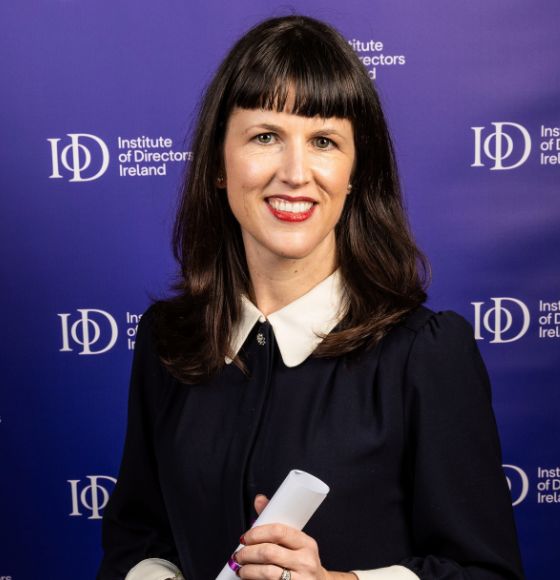
Evelyn Savage
Company Secretary & Director of Legal and Sustainability, IPB Insurance
Evelyn Savage has over 15 years’ experience in the insurance sector. She is a qualified solicitor, with a background spanning legal leadership, company secretarial roles, and ESG implementation in Irish and international insurers.
Your path into governance, legal and sustainability leadership was not a straight line. How did it all start for you?
I began with a psychology degree at UCC, and my final year project in forensic psychology first sparked my interest in law. I decided to pursue a postgraduate diploma in legal studies in DIT to explore it in more depth.
That decision led me to the entrance exams for the Law Society of Ireland and into a traineeship with a general practice firm. It gave me exposure across multiple areas of law, which was both fascinating and immensely valuable. I found myself particularly drawn to litigation. I really enjoyed it, but I was conscious that as an external solicitor, you often leave your advice at the door. I wanted to stay closer to the decision-making process. That led me to move into an insurance company as a litigation solicitor.
You chose to move in-house relatively early. What drove that decision?
Working in insurance brought me closer to the business itself. I became increasingly interested in how the organisation operated and how decisions were shaped. To support that shift, I completed the Law Society diploma in in-house practice and moved into an in-house counsel role, which broadened my perspective significantly.
How did your role grow from legal into governance and sustainability leadership?
From there, I progressed into senior leadership as head of legal and company secretary. The remit expanded further as sustainability emerged as a strategic priority. That was a natural development and aligned closely with my own interests, allowing me to connect governance, legal oversight and long-term organisational responsibility.
What appealed to you about IPB Insurance and the scope of the role you hold today?
I joined IPB Insurance in 2023 and now lead across governance, company secretarial, legal and sustainability functions — the areas I am most passionate about. IPB is unique as Ireland’s only indigenous mutual insurer, with deep roots in Irish society and a strong social conscience. We are celebrating our centenary this year, which adds a real sense of purpose and continuity to the work. It is highly motivating to be part of an organisation with that heritage and relevance.
You’ve seen the company secretary role change significantly - how would you describe that evolution?
The role has evolved into a far more influential and strategic position. If you look at the Companies Act description of the role, it appears narrow and administrative in nature - minutes, agendas and annual returns. In practice, the role today is significantly broader and more impactful.
The modern company secretary operates at the centre of governance and board effectiveness rather than purely as an administrative support.
What does the modern company secretary need to bring to the boardroom now?
Today’s company secretary must operate as a senior governance adviser and strategic enabler. The role requires experience, judgement, and foresight, with the ability to anticipate the issues boards need to address, ensure the right information is available and create the space for informed consideration and debate.
A deep understanding of the business is essential. That was one of my motivations for completing the Institute of Directors Diploma in Company Direction. Across leadership, strategy, governance and finance, it significantly broadened my understanding of the organisation as a whole. It deepened my grasp of areas I thought I understood, particularly financial reporting and performance, and connected them more clearly to board decision-making.
The regulatory and governance environment has also grown more complex over the past two decades. The company secretary is expected to navigate that complexity and translate it into practical, workable governance structures that support, rather than hinder, good decision-making. The role is now firmly at the heart of the organisation and its strategic direction.
Beyond technical expertise, what personal qualities really matter in the role?
Technical knowledge alone is not enough. The role depends heavily on trust and relationships. Continuous engagement with management to anticipate and shape board agendas, as well as working closely with the board and chair to support effective oversight. It requires strong interpersonal capability, sound judgement and integrity. The role involves constantly balancing competing priorities, and that is precisely what makes it so engaging.
How do you think about good governance in practice, not just in theory?
I see governance as a framework for disciplined, values-based decision-making. Good governance keeps an organisation anchored to its purpose and values and ensures decisions align accordingly. Under pressure or in times of crisis, strong governance is reflected in calm, consistent, and principled judgement. Effective frameworks help leadership stay focused on long-term vision, strategy, values, and risk against the backdrop of an everchanging external environment.
Within that framework, the company secretary plays a central role. It is about bringing governance structures to life and embedding them in how the organisation operates. I have been fortunate to work in organisations where governance is genuinely embraced and valued. It is a powerful enabler of sound strategic decisions.
From your perspective, what makes a board truly effective?
High-performing boards are characterised by how they work together, through respectful, constructive, and well-informed debate. Diversity of experience and perspective strengthens discussion and leads to better outcomes. There must also be a willingness to challenge appropriately and to ask the more difficult questions. Effective boards also strike the right balance between forward-looking strategic discussion and compliance oversight.
How can boards continue to strengthen their effectiveness over time?
Continuous development is vital, both individually and collectively. Directors need to develop their own capabilities, but boards also carry collective responsibility and must develop as a unit. That comes through shared learning, structured evaluation, and reflection. A well-run board evaluation generates valuable insight and, when acted upon, meaningfully strengthens performance. At IPB, this takes place annually, with an external evaluation every three years, and it delivers real value.
Director capability is further supported through a structured training framework. In IPB, we maintain an actively managed training plan based on board skills matrices and identified development needs, reviewed on a rolling basis. Collective development enables boards to better understand emerging risks and strategic issues, which in turn supports stronger decisions.
Clarity is also one of the most underrated drivers of board effectiveness. A coach once told me, “clarity is kind,” and it has stayed with me. Clear roles, responsibilities, governance structures, and expectations are essential. Boards function best when their remit and accountabilities are explicit and well understood. External perspectives and thought leadership also add important depth to board discussions.
Our IoD board membership supports that development. It provides access to high-quality education, thought leadership and peer learning. The cross-sector exchange of perspectives is particularly valuable; it challenges assumptions and enriches thinking. When chairs and boards actively use evaluation insights and development opportunities, they can materially enhance board effectiveness and impact.