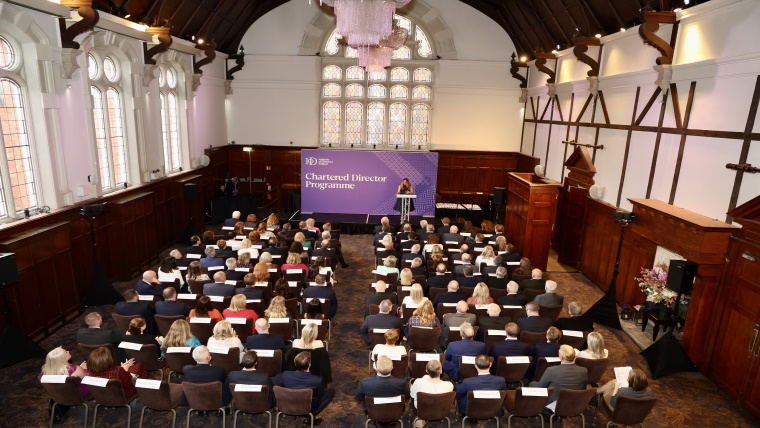
Chartered Director and experienced Non-Executive Director Gervaise Slowey CDir reflects on the importance of the art of governance.
The Ever Learning Board
The "ever learning board" is how IoD Ireland member and Chartered Director Gervaise Slowey describes what is required by organisations in the face of mounting challenges. "The whole world order is changing and business as usual just won't cut it," she says. "What I have found is that the best boards are those who benefit from diversity of experience, and who are curious and constantly searching to improve their collective knowledge. They engage in both collective training programmes as well as individual members having a learning mindset and doing their own deep dive training in areas like AI, cyber and sustainability. You have to be learning all the time, stay curious, and have the courage to ask the question that might sound stupid - because there is no such thing as a stupid question." For this reason, Gervaise unertook the IoD Chartered Director Programme to enable and guide her leadership in the boardroom. The Programme is designed to develop exceptional directors equipped to face the challenges of a globalised business environment.
Slowey made her name in the advertising world, first with BBDO in Europe and later with Ogilvy where she became Global Director on the Mondelez business as well as Managing Director of Ogilvy & Mather Dublin, before moving on the head up Communicorp, the Denis O'Brien controlled radio group, in 2013.
"I knew Communicorp would be an incredible experience for me," she says. "I really like the company and what they were doing. I liked the entrepreneurial spirit, the speed and the agility of a company like that, which you don't get in big multinationals. It was a fast-paced environment and a steep learning curve having not worked in radio before. As CEO I was responsible for every single detail of the business, including growing audiences, revenues and EBITDA in a very challenging market. I built a high-performance team around me and we grew the business. I'm very proud of what we achieved together."
Stepping into the Non-Executive Director Space
She had already dipped her toe in the independent non-executive director (INED) water the previous year when she joined the board of Eason's. "It was a very challenging time to join, " she recalls. "People were no longer reading books the way they used to. The era of competition from smartphones and social media for consumer's headspace and discretionary spare time had arrived. The business has expanded in recent years with several acquisitions including Dubray and many new store openings. It is now very focused on what it does best, which is a retailer of books, stationery, cards and gifts with a superb online business."
The move out of full-time executive roles and into the INED space exclusively was prompted by an approach to join the board of Ulster Bank in Ireland. "That crystallised thoughts I was already having, and I made the decision to leave Communicorp and further build my INED portfolio."
She joined the Ulster Bank board in April 2018 after an exhaustive approval process which included Central Bank interviews.
It was seen by some as an unusual move for her to join a bank board. “Group think was identified as one of the key factors behind the global financial crisis where banks had too many of the same type of people on their boards. By 2016, they deliberately sought non-executive directors from outside the industry. In my case, they asked me because I was from a consumer background. I cannot emphasise enough how important board diversity is, and the benefits can be seen in the better culture and resilience in banks since then. In my experience, good boards encourage independence of thought and build trust and respect so that board members can constructively challenge and feel confident to do so.”
She currently sits on the boards of WFBI, the Wells Fargo legal entity for the EU27, where she chairs the nomination and remuneration committee, and UK venture capital company Molten Ventures where she chairs the sustainability committee. She also remains a director and ESG committee chair for Dalata Hotels pending High Court approval for its sale to Pandox and Eiendomsspar.
The Different Remit of the Executive and Non-Executive Director
The difference between executive and non-executive roles can take some adjustment, she points out. "It's very exciting being a CEO or an executive director because you're in the thick of it, you're in the cut and thrust of running the business. You are involved in the business day to day and are very much a part of things. This is not the case when you are a non-executive, and you have to become accustomed to that, understand where the line is and make sure you're not overreaching.
“The non-executive role includes the development and challenge of the company strategy, overseeing the performance of management in delivering that strategy, deciding on executive directors appointment/removal, and determining how they are rewarded. It includes the integrity of the financial controls and the financial reporting and ensuring that risk management is adequate and robust enough. A critical role of the board is making sure the right culture exists in the company to support delivery of the company’s strategy.”
Non-executive directors need to be mindful of the difference in the roles. “There's a thing in the non-executive world you have to learn, which is nose in, fingers out. It is not your role as a non-executive director to manage the business and once you start doing that or trying to direct the CEO, you are not doing the job required of a non-executive.”
The Chartered Director Programme
Her experience on the Eason’s board while still in an executive role with Communicorp helped prepare her for the transition, as did the Institute of Directors (IoD) Ireland Chartered Director Programme.
Gervaise comments that “the IoD Chartered Director Programme and all IoD director training is outstanding. The content is rigorous and highly relevant, but equally valuable are the people you meet and the network you build along the way. It also gives you the skills to help understand things like what good governance practice looks like, how to develop and challenge strategy, indeed what a good strategy actually looks like, and for non-financial people, how to analyse financial statements, and how to assess the financial performance of a company. These are skills that are essential to being a good director”.
Adding, “I can’t recommend IoD Ireland membership and the Chartered Director programme highly enough to really support you on that director journey.”
Direct Advice and Building Your Non-Executive Director Portfolio
Her advice to others considering building a portfolio of board memberships is to “be crystal clear as to what you have to offer boards. Understand how you can be useful. In some cases, of course, your executive director experience could be enough. But that's increasingly rare. Companies will have sector specific expertise within their executive team. It's the other skills they may need which could enhance your appeal. In my case, being frank, my advertising and media background wasn't what interested my boards, what they wanted was the customer focus I could bring. I had also developed experience chairing remuneration, nomination and sustainability committees. These are important skill areas for boards.”
“The other thing to keep in mind is that there's a lot of competition in this space,” she concludes. “You can't sit back and wait to be discovered. You have to do a lot of work to get on the radar for a non-executive board directorship and it can take many years to build a portfolio. In saying that, I have found that working at this level with companies as very different from each-other as banking is to books, venture capital and hotels to be incredibly interesting and highly fulfilling as a profession.”
This article was originally posted on the Business Post.
Chartered Director Programme
Ready to up your game as a director? Learn more about the IoD Chartered Director Programme.