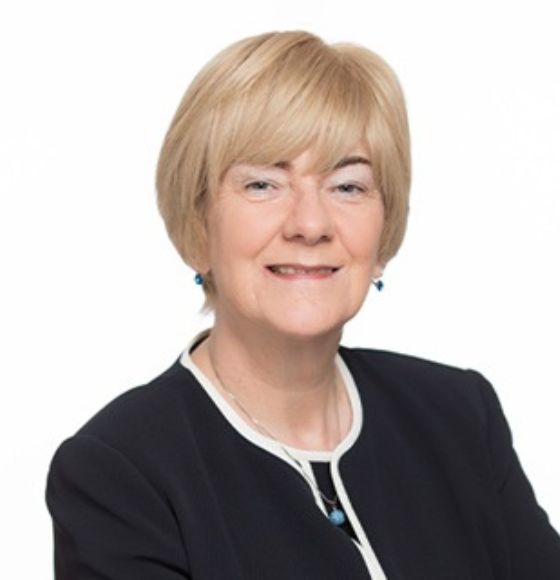
Sharon O'Brien
Chair and Independent Non-Executive Director
Sharon O’Brien is a seasoned Chair and Independent Non‑Executive Director with over 30 years’ experience in IT, business transformation, and strategy across the insurance sector, and a background as CIO, COO, and CEO.
Your career has, in many ways, come full circle. How do you reflect on that journey today?
I joined Aviva, then Hibernian Insurance, straight out of college in Belfast with a computer science degree in the 1980s. Nearly four decades later, after building most of my career in insurance, I returned to Aviva, initially as an Independent Non-Executive Director and more recently as chair of its general insurance business in Ireland. It feels like a meaningful way to close the circle.
How did you find the transition from an executive role into an independent non-executive position?
Although I was returning to a familiar industry, the role itself was fundamentally different. I retired as Global Business Agility Leader with Liberty Mutual on 31 December 2021 and became an INED of Aviva the very next day, having already gone through regulatory approval.
I had to sit on my hands a bit for the first few meetings. I wasn’t a business-as-usual executive. I thrived in flux, change, strategy, the high-octane side of business. I knew that shift would be the biggest challenge.
What was the hardest part of that transition for you personally?
I had to make sure I was ready to go from doing to challenging in a supportive way. That was the hardest part of the transition. I like to think I managed it well, or I doubt they’d have asked me to go forward for the chair role.
Looking back at your early career, what experiences most shaped your leadership approach?
I spent 27 years with Aviva, progressing through a wide range of leadership roles before relocating to its European Product and Investment hub in Dublin. In 2012, when the company restructured remaining in the organisation would have required a move to a senior role in Norwich, so I made the difficult decision to take redundancy. It would have meant four days a week away from my young children. It was too big a sacrifice. It surprised a lot of people at the time, but I trusted that things would work out.
What did your move to Bord Gáis Energy expose you to?
My next role, leading change management in Bord Gáis Energy, exposed me to a fresh organisational culture and pace. It was a very young demographic and an incredibly energising place to work.
What led to your move from CIO into broader operational and executive leadership roles?
In 2015, I returned to insurance as Chief Information Officer for Liberty Insurance Ireland. The contrast in physical environment was stark, but I embraced the challenge. I focused first on addressing the company’s critical IT challenges. I had to be very honest with the board about how serious the issues were. It was a steep learning curve, but I had the board’s trust.
Over time, my remit broadened and I was asked to take on the role of Chief Operating Officer, where I was able to draw on experience from earlier roles to help reimagine aspects of the operation, including a major refurbishment of the Blanchardstown premises. Shortly afterwards, I was asked to step into the CEO role.
Coming from an IT background into a CEO position was unusual, but I was comfortable with the challenge and focused on what the organisation needed at that point.
What did your global role at Liberty Mutual give you that previous roles had not?
Following a reorganisation of Liberty’s European businesses, I was appointed Global Business Agility Leader, reporting to the group Retail CIO in Boston. Working with US and European colleagues, I jointly led a digital transformation programme for the Western European market, starting in Ireland and extending to other geographies, including Vietnam. It was an extraordinary opportunity to deliver what I had wanted to achieve as CEO, albeit from a different vantage point.
What was happening for you personally and professionally when you began considering a board role?
The Covid period prompted reflection. I began thinking about my next life stage, the potential to do other things and spend more time with family in Ireland. When a head-hunter approached me regarding a board opportunity, later revealed as Aviva, I decided to take early retirement. It felt like a meaningful way to close the circle.
What guides you when deciding where you can add the most value as a non-executive director?
I became chair of Aviva’s Irish general insurance business in mid-2025 after a competitive process. I also serve on the board of FFH Management Limited, part of Fairfax Insurance’s global network.
I’m not a portfolio INED. I want to be on boards where I can contribute deeply and where the cultural fit is right. You must let the executive team reach their own conclusions. The role is to support, challenge thoughtfully, and ensure risks and implications have been fully considered. Humility, respect and intentionality were central to her my transition. You’re there to help steer strategic direction, not to do the doing.
What role do boards play in shaping organisational culture?
Boards play an essential role in shaping organisational culture, an area of increasing focus under the Individual Accountability Framework and the Fitness and Probity regime. It’s about ensuring the organisation’s value system is right and that employees feel safe to speak up. I’m a strong believer in meeting teams and seeing the culture in action.
Customer stories, particularly those arising during Storm Eowyn, reinforced how culture manifests in practice. It was powerful for the board to hear how colleagues cared for customers in vulnerable situations. That’s culture in action.
I believe that effective boards help identify issues without assigning blame. You need a positive dynamic so that when something doesn’t feel right, raising it enables solutions. Punitive approaches don’t work.
How do you view the role of the chair today?
I see the chair’s responsibility as balancing conformance (risk, compliance, fiduciary duties) with performance (commercial outcomes). The days of boards simply receiving papers and ticking boxes are gone. Effective boards are working boards. A key obligation for boards, in my view, is ensuring that organisations can withstand volatility and keep pace with external change.
That cohesive dynamic between the executive and board is essential. The focus must be on long-term sustainability. That future-oriented mindset is something I care deeply about.
How has IoD Ireland supported your development as a chair and INED?
I would absolutely recommend IoD Ireland membership to both current and aspiring INEDs. For me, the real value lies in the combination of high-quality learning, networking and confidence-building that it provides at each stage of the board journey.
The IoD Ireland training for chairs, in particular, really resonated with me. It offered practical insight into the realities of the role and reinforced the importance of judgement, balance and effective board dynamics, all of which I draw on regularly in practice. The breadth of online resources and the calibre of events are excellent, and they provide an ongoing source of perspective and professional development.