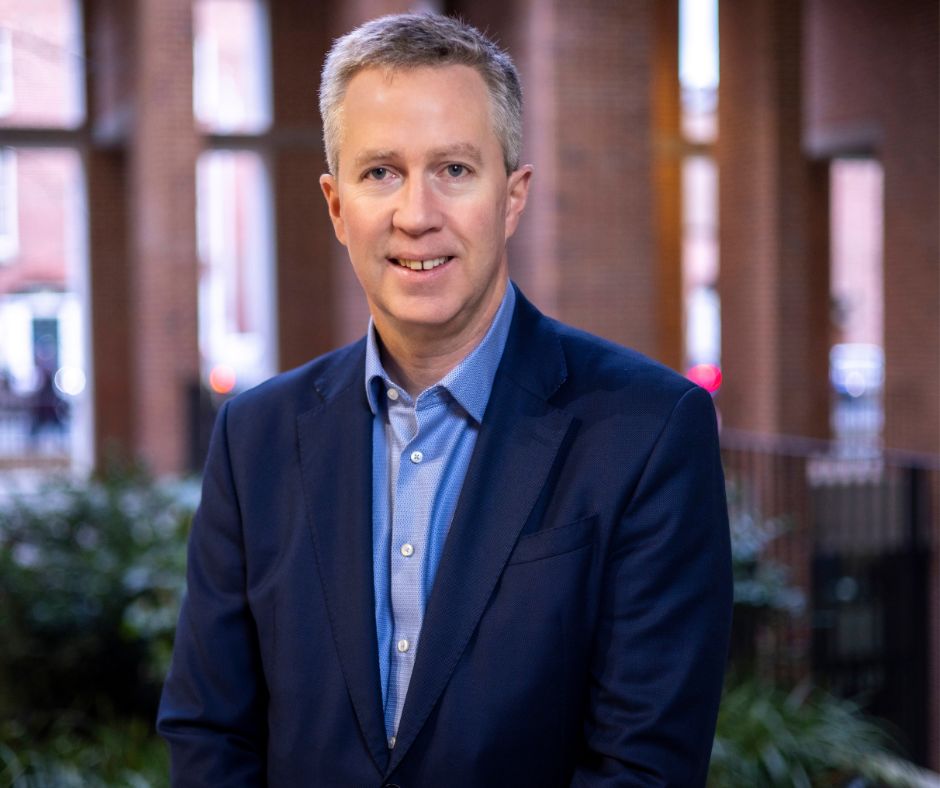
Paul Stapleton CDir
Executive Director, Group Finance and Commercial, ESB
Paul Stapleton CDir has had a 34-year career with ESB. During that time, he has held a number of roles including Group Treasurer, Electric Ireland General Manager, MD of Northern Ireland Electricity Networks and, most recently, Executive Director, Group Finance and Commercial.
You have had a 34-year career with ESB. How would you describe that journey?
It’s one of the great things about ESB. You can fulfil many different roles within what is a very large and diverse organisation. That scale is significant, with over 10,000 employees and assets approaching €20 billion. It's a very significant entity in those terms, but more importantly it is a key cornerstone of the energy industry in Ireland with a very significant presence in the United Kingdom as well. About 30 per cent of our business activity is in the UK at this stage. We have a very large footprint in a diverse range of areas from retail to infrastructure to energy trading to telecoms.
What shaped your leadership style over the years?
When you're managing activity that you're reasonably familiar with, it's easier in some respects, but can give you a narrower focus as a leader. When you move on to roles where you're managing activities where you have less specific subject matter expertise it requires a different leadership style. You learn to trust and rely on others more. You learn to focus on people and relationships more. You rely more on the views of others as they're the experts. It’s a healthier leadership style as well.
At group leadership level, you do need to be more strategic. You need to be more focused on governance aspects and making sure things are done in the right way rather than on immediate process or delivery. It's also about aligning with the purpose of the organisation. Why do we exist? What are we trying to achieve? And making sure what we're doing is aligned with that. You have to bring that different perspective and try to stay out of the day-to-day detail of the business operations. We have very capable, competent and committed people looking after that.
How does the ESB board balance its responsibilities?
The ESB board is making decisions on many different issues and across different time horizons. We currently invest about €2.5 billion per annum in infrastructure, up from €1 billion just a few years ago. Those investments are typically in large long-term infrastructure projects. We're taking a view not just years but decades ahead. As we all know the future is uncertain. You're trying to navigate through that uncertainty, weighing up the risks, the opportunities, taking account of our regulatory requirements, our licence obligations, our shareholder expectations, what customers and society needs, and taking balanced disciplined decisions that ultimately align with our long-term strategy.
How do commercial and societal considerations intersect?
I often say our purpose is not to make money, but we have to make money to fulfil our purpose. We have to apply a commercial lens to everything we do. But as a semi-state government owned entity and being the provider of an essential service that's critical for the economy and for society, we can't and don't just consider the commercial aspects.
We have to do what's best for customers and the wider economy and society and indeed the environment and the planet. A key part of our strategy is about delivering energy that's not just available, reliable and affordable, but ultimately that's clean and sustainable. We've set a strategy of net zero by 2040, which is very much aligned with Government's climate objectives, but we have to do that in a way that's balanced and takes account of commercial objectives along with wider stakeholder interests. Directors today must be strategic but also grounded in purpose and governance.
What are the biggest challenges facing boards today?
Governance is becoming more complex and more onerous for boards generally. We are living in a much more regulated world, particularly in Western Europe. Trying to balance commercial considerations with the broader aspects of ESG and the associated reporting is a growing and complex issue for boards. Artificial intelligence is another. It is already a significant topic for most boards but will become even more so from a governance perspective. Availing of the opportunities while balancing and managing the risks associated with AI is already very tricky and I think it's going to get even more tricky over the next number of years.
And, of course, decarbonisation. That's at the core of our strategy, but low carbon energy has to be reliable and affordable as well. That's the energy trilemma that we often speak about. In Ireland, we've a particular challenge because not only have we to decarbonise an energy system, but we have to do it at the same time as catering for a rapidly growing economy and population that is putting strains on the system. The whole energy transition is very much core to ESB’s strategic priorities and everything the board does.
What role will different energy sources play in achieving net zero?
We need to maximise the potential Ireland has for offshore and onshore wind energy. Solar energy is a significant part of the solution as well, but they are both intermittent technologies. We need to balance that with more storage, more interconnection, more flexible demand solutions. The plant that's currently running on gas is likely to be part of the system for many decades to come, but hopefully before too long it can be burning low carbon fuels like HVO or hydrogen rather than carbon emitting fuels.
How has IoD Ireland supported your journey?
I first engaged with IoD when I was in Northern Ireland. I found that it punched above its weight in terms of influence. I joined the IoD committee in Northern Ireland, and I found that a very useful network. That led me to doing the Chartered Director Programme, which I found really beneficial for my role at the time because I was transitioning from general management to board level. I'd certainly recommend that to anybody who is considering a move into a board role.
When I returned to Dublin, it was a natural step for me to engage with IoD Ireland, and I found it to be very useful as well. They run some really interesting events and it's a good way of building a network and getting access to thought leadership on different topics and keeping abreast of current issues. It gives people the tools to help them attain those standards. That's a very positive contribution and particularly valuable at a time when standards of governance in the broader sense are coming under threat from a trend towards a more expedient leadership philosophy in some parts of the world. I think we need to be very careful as a society where we go with that and organisations like IoD Ireland are never more valuable than in terms of promoting good governance, good leadership, and the right way of doing things to the right standards.
What advice has stayed with you during your career?
The best advice I received was not to be defined by your qualifications or the previous experience you’ve had. It's about seeking to broaden your experiences. I remember one manager earlier in my career said to me it's about committing 100 per cent to the role you're in but keeping a very open mind about what the next one might be. That's a simple enough kind of approach, but it's not a bad one and I’ve found it useful.
And what advice would you give to your younger self?
As a leader, very little is achieved alone. We constantly rely on and place trust in others. Today’s world is far more complex, and we’re more dependent on people - both inside and outside our organisations - than we may have realised earlier in our careers. That’s how my thinking has evolved.