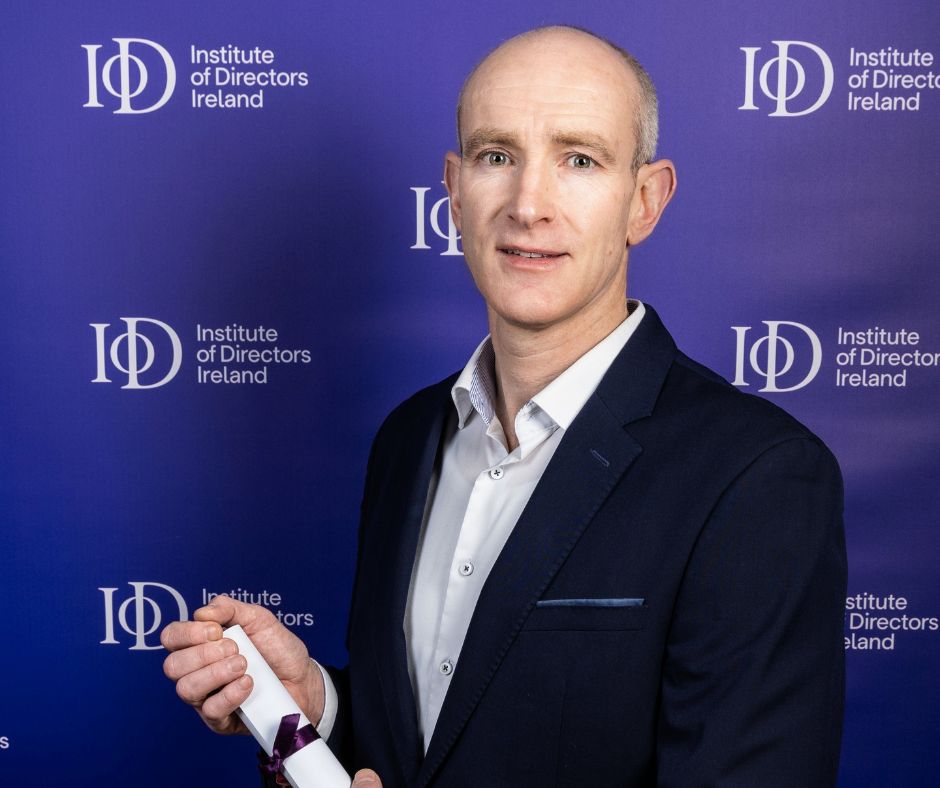
Karl Tuffy CDir
Chartered Director, Advisor and Entrepreneur
Karl Tuffy is a Chartered Director, Advisor and Entrepreneur with over 20 years’ experience in executive leadership and global commercial development. He currently advises companies on scaling, sustainability and ESG‑driven excellence.
You began your career as an engineer and went on to co-found and lead a highly specialised manufacturing business through to acquisition. Looking back, what were the key inflection points that shaped your journey to the boardroom?
My career has been shaped by a strong commitment to continuous learning. After completing my Mechanical Engineering degrees at UCD and a research masters, I co-founded NanoDiamond Products during the 2009 financial crisis. As I stepped into the CEO role, I quickly realised that technical excellence was not enough. Building a scalable business required stronger leadership, governance and strategic discipline, so I invested in executive development and evolved towards a more distributed leadership style, with a clear focus on building a robust governance foundation.
Following the sale of the business to KKR as part of their Industrials portfolio, working within a US-based global corporate environment further reinforced the importance of board-level capability. Completing the IoD Chartered Director Programme proved transformative, equipping me with the insight, confidence and practical tools that underpin my current portfolio career as an advisor and Independent Non-Executive Director.
What experiences – good or bad – have most influenced how you now show up in board or advisory roles?
Early in my career, I sometimes hesitated to act assertively, particularly in complex situations such as managing conflicts of interest with shareholders and external auditors. Navigating the sale of the business to a global private equity owner showed me first-hand the value of trusted independent advisors and the discipline of strong governance.
Today, I bring a very different mindset to board and advisory roles. Grounded in that experience and shaped by the IoD Chartered Director Programme, I operate with professional independence, clarity and decisiveness, applying sound judgement from both a founder’s and corporate executive's perspective, to help boards navigate complexity and make better decisions.
You have moved from founder-CEO into advisory and governance roles. What has been the most material shift in mindset when operating at board level rather than in executive management?
The biggest shift is moving from doing to enabling. As a founder and executive, you are deeply involved in decisions. At board level, your role is to set direction, provide oversight and exercise independent judgement – not to run the business.
I learned the importance of clearly defining the role of advisory boards versus governance boards, and of empowering executive teams through distributed leadership. Advisors and advisory boards align to a charter with a carefully defined scope and all decisions remain firmly with sponsors and client, not the advisors. As an INED, independence is everything: bringing unbiased challenges, acting with integrity, setting the direction and making critical decisions in an informed manner with a duty of care and loyalty.
Having led a business through international growth and acquisition, what questions should boards be asking management earlier in the growth journey?
Boards need to ask two simple but powerful questions early: Are we truly ready to scale? and What risks are we taking on in doing so?
In SMEs, it is never too early to discuss exit and succession planning, and to ensure the right bench strength is in place to handle growth. As organisations scale, culture becomes a primary risk – acquisitions fundamentally disrupt authority, geography and identity, so alignment to purpose and values is critical.
In larger corporate environments, the focus shifts to operational readiness: do we have the infrastructure, systems and leadership capability to double in size without damaging the core business? Boards must be relentless in challenging readiness and integration risk.
Founder-led businesses are a huge part of the Irish economy. What governance challenges tend to emerge as they scale, and how can boards support long-term success?
Founder-led businesses often struggle with three things as they scale: cash discipline, clarity of roles and independent challenge.
Overtrading can quickly undermine a great business, blurred boundaries between shareholders and directors lead to poor decisions, and groupthink emerges when boards lack true independence. The board’s role is to introduce discipline without dampening ambition – ideally with an experienced independent chair who can guide the business through each stage of growth.
What risks do you think boards need to be thinking more proactively about?
Financial resilience, talent and market foresight sit at the top of the agenda. Currency volatility can wipe out profits far faster than most boards expect. Succession and retention at translational leadership levels are critical to sustainable growth.
Boards must also lift their gaze to where the market is going – understanding changing demographics, customer needs and competitive dynamics. ESG and AI both bring significant opportunity and risk, and without clarity of purpose and values, boards will struggle to make confident, coherent decisions in either area.
If boards could improve just one behaviour to be more effective, what should it be?
Independent thinking, free from self-interest.
Boards need professional, courageous directors who are self-aware, act with integrity and are willing to challenge constructively – not for personal gain or preservation, but in the best interests of the organisation.
How has your involvement with IoD Ireland supported your development as a director or board advisor? What role do organisations like IoD Ireland play in helping executives make the transition to effective board roles?
IoD Ireland has been pivotal in my transition to a portfolio career. The Chartered Director Programme strengthened my capability across finance, strategy, governance and risk, but just as importantly it reshaped how I think and behave in the boardroom. It gave me the confidence to act with independence, ask better questions and add real value as a director. IoD Ireland provides the gold standard in preparing executives for the boardroom.
It helps leaders unlearn executive habits, build board-level competence and step into governance roles with clarity and confidence – ensuring they can provide both robust challenge and meaningful support from day one.
Finally, what advice would you give to directors who want to stay relevant and effective over the next five years?
Never stop learning.
Directors should see themselves as a strategic asset and invest in their own development on an ongoing basis. Stay curious, build a diverse network and continually ask: What value am I adding today, and how will I add value tomorrow?