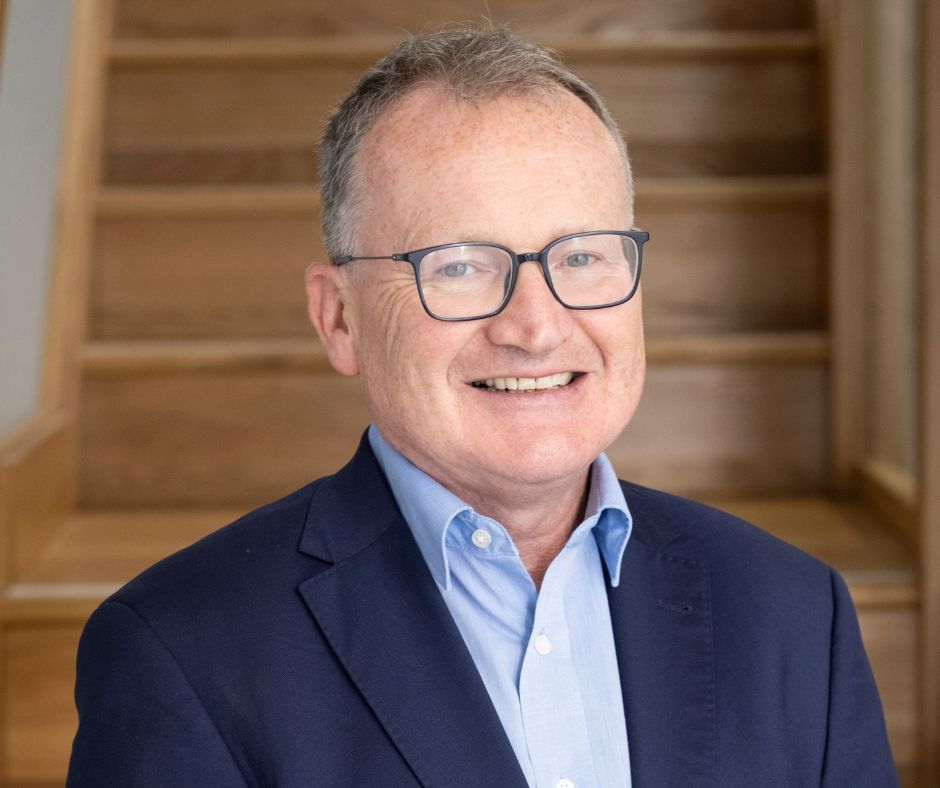
Jim Power
Economist and Non-Executive Director
Jim Power is a well-known Irish Economist and Media Commentator, and Non-Executive Director. He has held senior roles in major financial institutions and regularly contributes to national media on economic issues. He also co-hosts the podcast The Other Hand and is the author of Picking Up the Pieces, which explores Ireland’s financial recovery.
From your experience on boards such as BMW Financial Services and Arboretum Garden Centre, what do you see as the most important qualities and contributions an Independent Non-Executive Director brings to a boardroom?
I think that an Independent Non-Executive Director (INED) who is not directly involved in an industry or business can bring a broader perspective to board discussions. The INED should ask ‘dumb’ questions that may make the Executive uncomfortable, but will very often unearth really interesting insights and get the board and the management team thinking about the business in a very different way. I think an INED should seek to challenge, not just for the sake of it, but when there is a good reason to challenge. An INED possibly has a greater ability to ‘see around corners’, because from an independent position outside the business, it is very often possible to see stuff that those involved in the business might not be able to see, as they are just too closely involved. An INED has certain experience and skills, and I think it is important to see how that experience and skillset can be applied to the board discussions and the business. An INED also needs to have a strong sense of curiosity. The most important – independent.
What are the most pressing challenges you see boards facing today, whether in financial services, retail, or the food sector, and how should boards adapt to meet them?
To me the impact of AI on the business and cyber risks are the two most pressing challenges facing every business across a broad spectrum. AI has the ability to fundamentally alter and disrupt many businesses in a very dramatic way, and I am not convinced that many boards actually have the skillsets to figure out how it might impact, and more importantly how to pre-empt the impending impact. Rules-based businesses are particularly open to AI-driven disruption. The impact does not necessarily have to be negative, it can also be very positive and beneficial for a business.
Cyber-terrorism is now a truly global phenomenon and one that can do serious damage, if not destroy a business. The reality is that those involved have vast resources, as it is generally multi-national organised crime driving it. Many businesses simply do not have the expertise or resources to deal with it adequately. It has got to be top of the risk register.
Reputational risk is also of vital importance. It takes years to build a reputation, but it can be destroyed in minutes. A board needs to understand all of the factors underlying reputation and make sure they are constantly monitored.
While ESG is out of fashion to some extent, sustainability is the new catchphrase.
How do you see the role of the board in balancing oversight with supporting management on strategy and long-term growth?
The board needs to provide appropriate oversight help guide the long-term strategic direction of a business and help ensure that the structures and resources within the business are adequate for the strategic direction and the achievement of long-term growth. The board also needs to support management in ensuring that the culture of the company is aligned with the strategy.
Given your background as an economist, how should boards approach decision-making in times of economic volatility and uncertainty?
I would say this as an economist, but I think it is vital for every board to be aware of and understand the economic environment in which the business operates. The economic risks need to be included on the risk register and the mitigation measures outlined clearly. The economic opportunities also need to be understood clearly and exploited where possible. Issues such as the general domestic and international growth environment; interest rates; demographics; labour market conditions; the price and cost environment; geo-political risk; supply chain resilience; and Government policies all need to be considered in decision making. Of course, the current threat to free trade and the tariff regime that is evolving are front and centre at the moment. During times of economic risk and uncertainty, a business must be agile and flexible, and capable of making quick decisions. The board needs to support this to the greatest extent possible.
Having chaired Love Irish Food for many years, what insights can you share about the board’s role in representing stakeholders and maintaining trust with customers and communities?
In Love Irish Food the imperative was always to support member brands in every way possible and ensure that they get value for their membership fee. It was an easy role, given how fantastic and exciting food and beverage brands are. For food brands, reputation is of paramount importance, and it was always vital that the board provided advice and assistance to member brands and encouraged exchange of ideas. Constant communication was vital.
In your view, what makes for a well-composed board, and how important is diversity of thought, background, and skillset in effective board decision-making?
It goes without saying just how important diversity is on a board. Diversity should include gender, skills, social background, and thought. Gender diversity is particularly crucial, not just for ESG reasons, but because of the different approaches and perspectives that the genders bring to the table. Diversity of skills is also essential, particularly in the much more uncertain and risky world that business now operates in.
Drawing on your own journey from economist and commentator to Independent Non-Executive Director (INED) and chair, what advice would you give to those seeking to step into non-executive board roles?
My advice is ‘go for it.’ As an economist I always felt I lacked real world business experience and operated in somewhat of a vacuum. Joining IoD Ireland and undertaking the Chartered Director Programme provided this real-world business insight. The experience I’ve gained through IoD Ireland and my Independent Non-Executive Director roles has really benefited my work as an Economist and in my MBA teaching at UCD Smurfit School. My real word of advice is to join IoD Ireland and consider undertaking the Chartered Director Programme.